

Story By: Nii Okpoti Odamtten & Muhammed Faisal Mustapha…
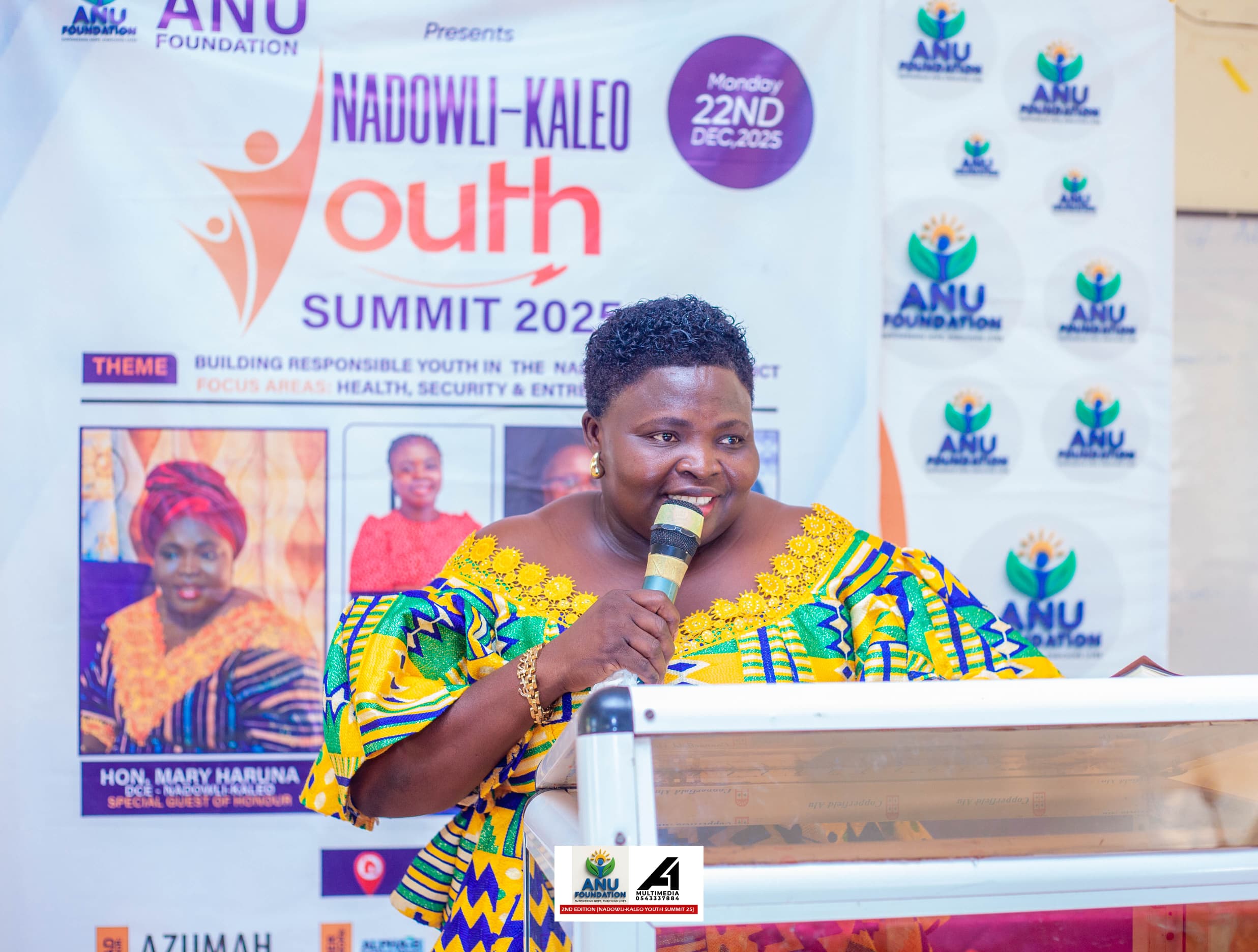
In a strong and reflective address that resonated deeply with both young participants and community leaders, the District Chief Executive (DCE) for the Nadowli Kaleo District, Hon. Mary Haruna, has challenged the youth of the district to embrace discipline, integrity, and community service as the foundation for sustainable development and future leadership.
Speaking at the Nadowli Youth Summit held at the McCoy College of Education on Monday, December 22, 2025, Hon. Haruna described the gathering as a defining moment in the district’s youth development journey.
“This summit is not a ceremonial event. It is a turning point one that demands reflection, responsibility, and action from every young person present,” she said.
The summit was held under the theme:
“Building Responsible Youth in the Nadowli Kaleo District.”
Moving beyond the traditional notion of youth as leaders in waiting, the DCE emphasised that young people must be seen as active partners in today’s governance and development process, not merely beneficiaries of future opportunities.
“The true measure of any society is not found in its wealth or natural resources, but in the character, discipline, and sense of responsibility of its youth,” Hon. Haruna stated.
She urged participants to see responsible living not age or title as the true pathway to leadership, noting that values driven youth form the backbone of peaceful and prosperous communities.
“Youth empowerment is not just a policy choice; it is a national priority and a moral obligation.”
Hon. Haruna highlighted key national interventions aimed at addressing youth unemployment and economic vulnerability, commending the administration of President John Dramani Mahama for placing youth development at the centre of Ghana’s governance agenda.
She cited the creation of the Ministry of Youth Development and the rollout of the Adwumawura Programme as landmark initiatives with direct relevance to districts like Nadowli Kaleo.
According to her, the Adwumawura Programme is structured to support the creation of 10,000 youth led businesses annually, offering training, mentorship, and access to funding.
“This programme is a clear demonstration that government believes in the creativity, resilience, and enterprise of Ghanaian youth,” she noted.
Providing a rare district level breakdown, the DCE revealed that the Youth Employment Agency (YEA) has expanded its footprint in the Nadowli Kaleo District, currently engaging 81 young people under the Community Support Module.
The beneficiaries include:
° 29 Community Police Assistants
° 12 personnel with the Ghana National Fire Service
° 24 with the National Ambulance Service
° 8 attached to the Ghana Prisons Service
° 6 Arabic tutors
° 2 beneficiaries under the Insurance Commission.
All participants, she said, receive a monthly allowance of GH¢800, offering both income support and valuable public service experience.
“These are not just numbers. They are lives being stabilised, skills being developed, and futures being shaped,” Hon. Haruna stressed.
“Responsible living today determines credible leadership tomorrow.”
Acknowledging the realities confronting young people unemployment, limited opportunities, and negative social influences the DCE urged the youth to look beyond despair and tap into emerging opportunities in agriculture, entrepreneurship, digital innovation, and community service.
She encouraged continuous education, skills acquisition, and ethical entrepreneurship, while calling on the youth to uphold peace, unity, and respect for diversity in an increasingly complex social environment.
“As District Chief Executive, I call on every young person to translate the ideals of responsibility into concrete action. The future of the Nadowli Kaleo District is in our collective hands,” she said.
Expressing optimism about the long term impact of the summit, Hon. Haruna said she believes history will remember the current generation as one that laid the foundation for a stronger, more prosperous Nadowli Kaleo District.
The summit brought together traditional leaders, government officials, youth groups, civil society actors, and other stakeholders, who deliberated on practical strategies for nurturing a responsible, empowered, and development oriented youth population.
As the discussions concluded, one message stood clear: responsibility is not optional it is essential.