

By Prosper Agbenyega
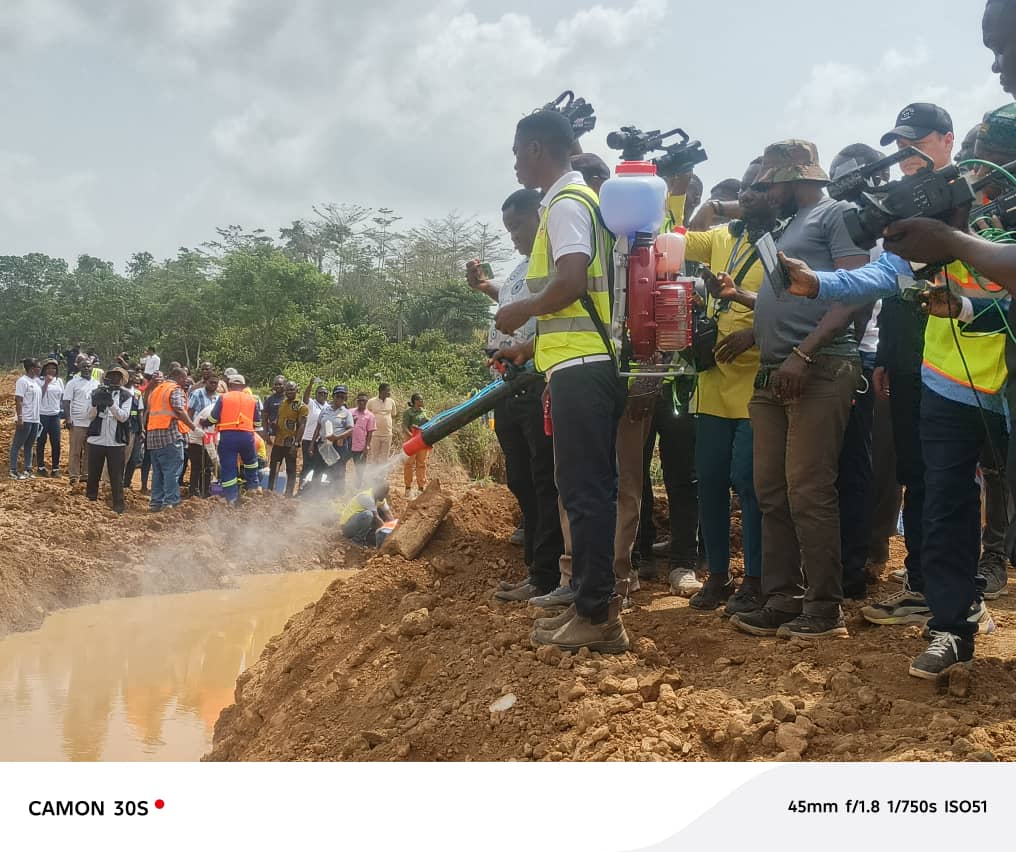
The Environmental Protection Agency (EPA) has undertaken a simulation exercise on the Birim River, applying a new Ionic Nano Copper-based technology aimed at restoring water bodies devastated by illegal mining activities, popularly known as galamsey.
The exercise was led by the Chief Executive Officer of the Authority, Nana Brown Klutse, in collaboration with officials from the Ghana Standards Authority (GSA) and the Ghana Water Company Limited (GWCL).
How the Technology Works
The innovative solution, known as Ionic Nano Copper Technology, is an organically formulated nano liquid applied directly to the surface of polluted rivers.
According to the EPA, the substance is left to interact with the water for approximately 45 minutes.
Within that period, nanoparticles bind to heavy metals and suspended particles. As contaminants settle with the sand at the riverbed, clearer water begins to flow on the surface.
The technology is currently at its pilot stage, with the EPA seeking an estimated $200,000 to fund broader testing and implementation.
Prof. Klutse explained that the Authority will engage small-scale miners and relevant government institutions to explore sustainable ways of deploying the solution nationwide.
She noted that Cabinet approval is yet to be secured for the proposed budget required to scale up the project.
Interestingly, during the exercise, portions of the Birim river which was used for the experiment became clear within an hour as indicated by the experts.
Scientific Testing and Safety Assurance
Dr. Awal Mohammed of the Ghana Standards Authority confirmed that water samples from the Birim exercise have been sent to various laboratories for detailed analysis.
He commended the technology, describing it as highly promising.
“When applied, it has no harmful effect on humans, and aquatic life is also sustained,” he stated, adding that preliminary observations indicate positive results.
Broader Environmental Context
The EPA plans to extend the pilot to heavily polluted rivers such as the Ankobra River, Pra River and Offin River, all of which have suffered severe contamination from illegal mining operations.
The Ionic Nano Copper solution is designed to function as an adsorbent, attaching to heavy metals in flowing water to enable their removal.
While the technology has undergone laboratory testing and has seen application in other jurisdictions, some environmental experts have called for more rigorous environmental impact assessments under Ghana’s specific ecological conditions to avoid any unintended secondary pollution.
Researchers at the University of Ghana have previously explored copper (II) oxide nanoparticles for photocatalytic treatment of industrial pollutants, highlighting the growing interest in nanotechnology for environmental remediation.
However globally, nano-copper technology is also recognized for its antimicrobial properties and has applications in agriculture and surface coatings.
As Ghana intensifies efforts to combat the destructive effects of galamsey, the EPA’s pilot initiative represents a potentially significant step toward restoring the country’s polluted rivers, pending further scientific validation and government approval.