

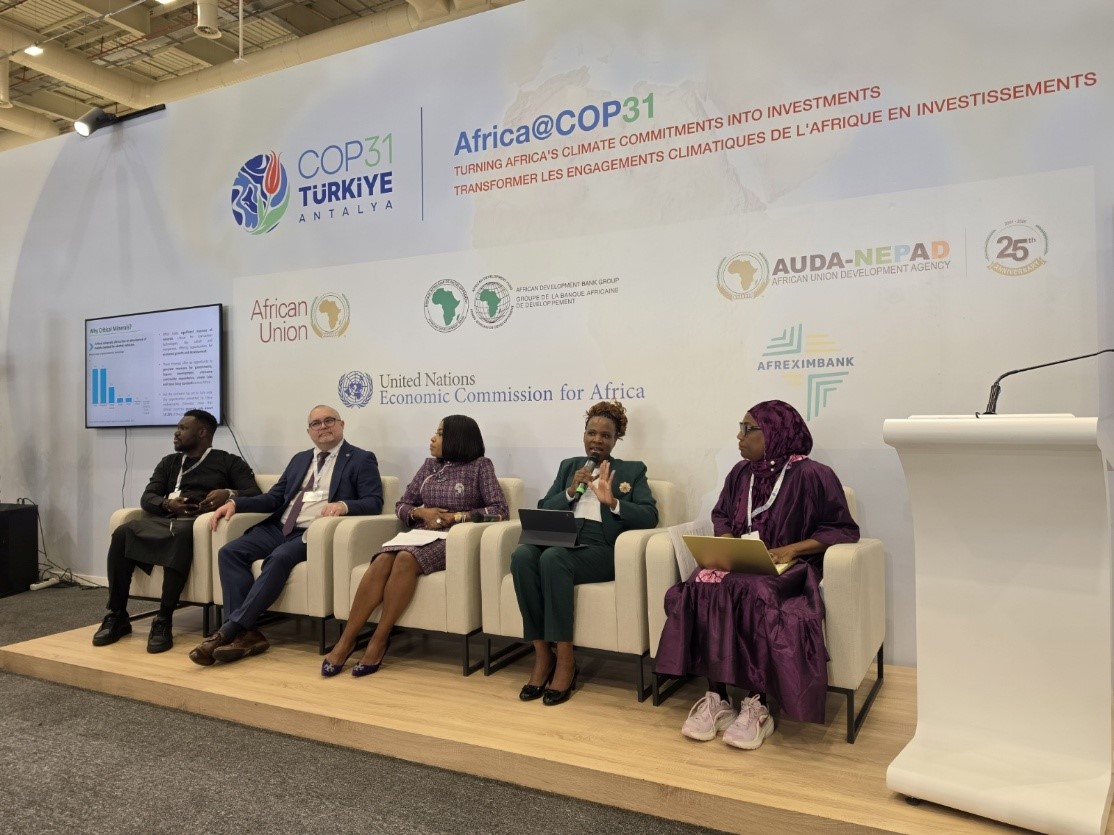
Africa must move beyond its abundance of critical minerals and focus on developing commercially viable green industrial projects capable of attracting investment, creating jobs and strengthening regional value chains, the African Continental Free Trade Area (AfCFTA) Secretariat has emphasised.
Ms. Roslyn Ng’eno, Senior Investment Expert at the AfCFTA Secretariat, made the case during a high-level panel discussion on green industrialisation organised by the African Export-Import Bank (Afreximbank) at the Africa Pavilion of the 31st United Nations Climate Change Conference (COP31) in Antalya, Türkiye, on 16 November 2026.
Addressing the continent’s industrial transformation prospects, Ms. Ng’eno stressed that access to critical minerals alone would not guarantee investment in Africa’s emerging green industries.
She highlighted the importance of developing bankable projects supported by reliable energy, adequate infrastructure, production capacity, identifiable market demand and predictable investment conditions.
These essential components, she explained, may be distributed across different African countries, making regional cooperation critical to unlocking investment opportunities.
The AfCFTA provides an important framework for connecting complementary resources, industrial capabilities and markets across national borders, helping African countries develop competitive regional value chains rather than pursue fragmented national projects.
The approach offers an opportunity for the continent to transition from being primarily a supplier of raw materials towards becoming a producer of higher-value industrial goods and technologies.
A major focus of the discussion was the Africa Green Industrialisation Initiative (AGII), which supports the preparation of integrated industrial projects capable of attracting investment.
The initiative is expected to strengthen efforts to identify and package commercially viable opportunities that combine Africa’s resources with infrastructure, production capabilities and regional market demand.
Ms. Ng’eno also highlighted preparations towards implementing the AfCFTA Protocol on Investment, which aims to support a more predictable investment environment across the continent.
Together, these initiatives offer a pathway for mobilising investment into green industries while promoting regional economic integration, value addition and employment creation.
The discussions reinforced the importance of translating Africa’s climate and industrial ambitions into concrete projects capable of delivering measurable economic benefits.
Looking ahead to COP32, scheduled to take place in Addis Ababa, Ethiopia, in November 2027, the AfCFTA Secretariat has identified the advancement of a credible pipeline of well-prepared green industrial projects as an important priority.
The ambition is to move beyond policy commitments and investment discussions towards implementation, ensuring that Africa’s green transition also delivers industrial development, stronger regional production networks and shared prosperity.
For African governments, investors and businesses, the message is clear: Africa’s industrial future will depend not merely on the resources it possesses, but on its ability to connect those resources, prepare investable projects and build competitive industries across the continent.