

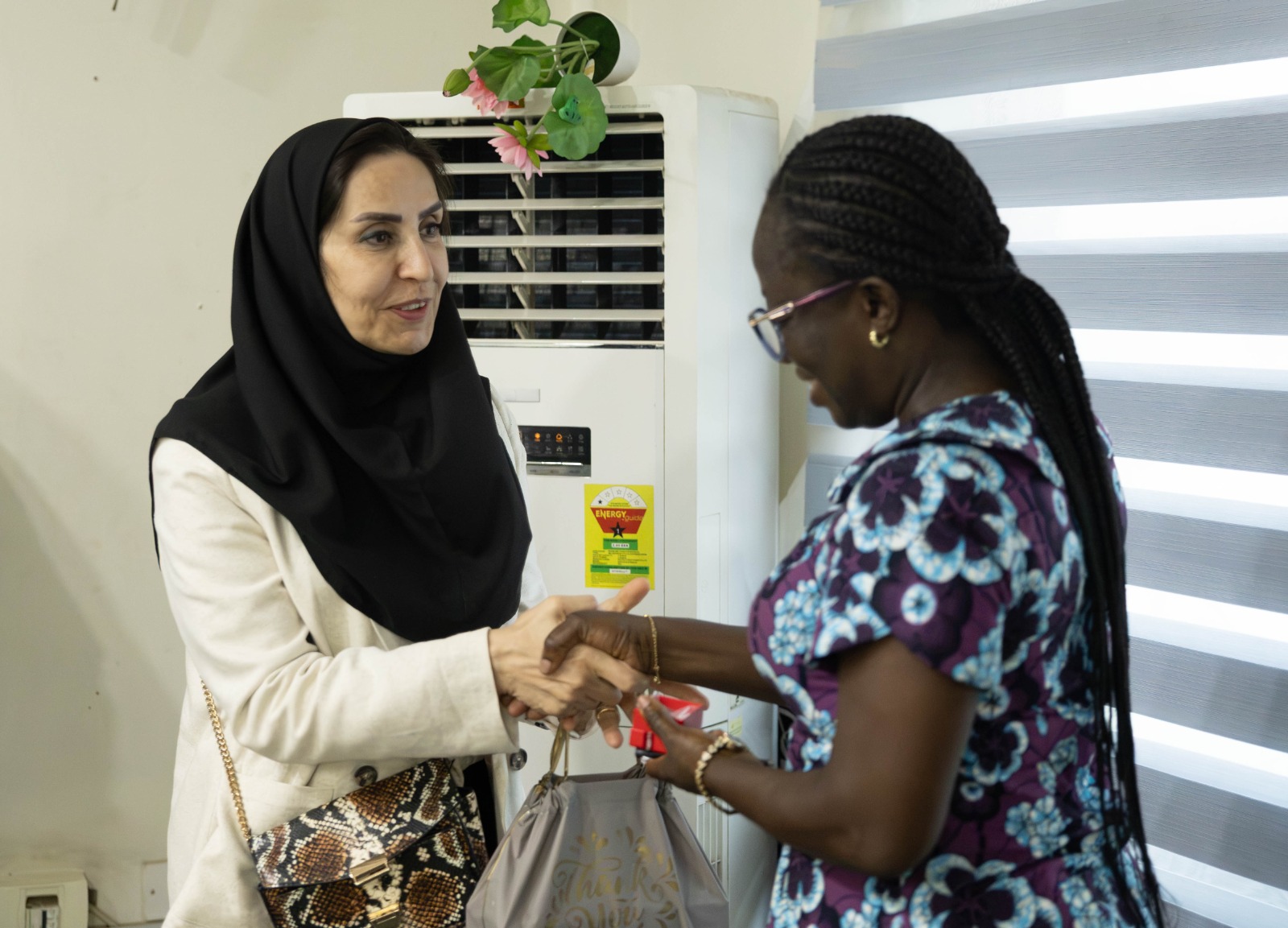
Two Iran University of Medical Sciences academics, in Accra to teach at the Islamic University, answer questions on women’s education, Iran’s health system and scholarships for African students.
Interview held at the Cultural Consulate of the Islamic Republic of Iran, Accra. Conducted by Muntawakilu Amadu. Persian responses translated into English.
In an interview hosted by Muntawakilu Amadu at the Cultural Consulate of the Islamic Republic of Iran, two visiting faculty members from Iran University of Medical Sciences, Dr. Mojdeh Tajari and Dr. Hanieh Gholamnejad, discussed their one-month teaching visit in Ghana, women’s participation in higher education and health care, Iran’s medical capabilities, and scholarship pathways for Ghanaian students.
The professors are in Ghana for a one-month teaching assignment at the Islamic University, where Iran University of Medical Sciences has established a branch in Accra. The interview was conducted in English and Persian. The host, Muntawakilu Amadu, joked that his Persian was “too powerful, too electric” for the occasion, and conducted the session in English. Dr. Maleki, who directs the Iran–Ghana health cooperation project, also made a closing statement on the partnership.
Dr. Mojdeh Tajari: holds a PhD in nursing and is a faculty member at Iran University of Medical Sciences. After years of hospital and university experience in Iran, she is teaching critical care nursing to master’s students in Ghana.
Dr. Hanieh Gholamnejad: holds a doctorate in nursing, specialising in medical-surgical nursing, and has more than 33 years of hospital and university experience. She is teaching master’s and bachelor’s students.
Dr. Maleki: is director of the Iran–Ghana Health-Focused Cooperation Development Project and the representative of Iran University of Medical Sciences in Ghana.
First impressions of Ghana
How long have you been in Ghana, and what has your experience been so far?
Dr. Mojdeh Tajari: Thank you for inviting us. I have a PhD in nursing and I am a faculty member at Iran University of Medical Sciences. I have worked and taught for years in hospitals and universities in Iran, and I am now here as a professor teaching master’s students in critical care nursing. We will be here for one month, and I am very happy to have this valuable experience. I hope I can be a worthy representative of Iran University of Medical Sciences in sharing my experience with Ghana’s nursing students.
Dr. Hanieh Gholamnejad: Thank you for arranging this programme. I am a faculty member at Iran University of Medical Sciences with a doctorate in nursing in medical-surgical nursing, and more than 33 years of experience in hospitals and universities. Like Dr. Tajari, I came to Ghana for a month to teach master’s and bachelor’s students. I hope I can be as useful as is expected of me, and more, and be a worthy representative of Iran.
Women and education in Iran
Education and the role of women are central to any society’s development. What is the status of women’s education in Iran?
Dr. Mojdeh Tajari: In recent years the situation of women in Iran has improved considerably, including in education. A very large number of women want to enter university. Close to 50 per cent of those who register for the national university entrance exam and enter university are women, and many go on to join the workforce. Women make up roughly 30 to 35 per cent of university faculty nationally, and the figure rises to nearly 40 per cent in medical sciences universities. That shows how many educational and professional opportunities exist for women in Iran.
Dr. Hanieh Gholamnejad: Women’s education is a trend that began long ago and has made notable progress. In Iranian families, education has a special place for both women and men, and in recent years its importance for women has grown even more. Women have realised that by studying, working and being more present in society, they can gain independence, capability and the self-esteem every woman needs. Through their effort and perseverance, and the conditions made available to them, women are now the majority of Iranian university students. Roughly half of Iranian students are women and half are men. We are very pleased that this awareness has spread among women and that their hard work has carried this progress forward.
In some parts of the world women are confined to household duties, and schools enroll fewer girls than boys. What is the ratio of female to male students in Iran?
Dr. Mojdeh Tajari: You may hear reports about Iran on social media that often do not match the reality of our society. Before we came here, we also heard things about Ghana. When we arrived and saw the beauty of this country, its culture and its people, we realised social media had not told us the whole story. The same is true of our country.
In most cases there is no restriction on women’s education or employment in Iran. Where such cultural restrictions exist in a few places, within certain families, they are becoming fewer as awareness and public information campaigns spread. Women in Iran have stood alongside men in every field: in universities, in workplaces and in management, where the number of women managers has grown. About 33 per cent of faculty at Iran’s universities are women, and in medical sciences universities about 40 per cent are.
I must also say that Iranian women worked very hard to reach this position. They faced the same difficulties as women everywhere: being mothers and wives and carrying other responsibilities. Through their efforts they overcame those limitations and took their place in society, enduring every hardship along the way.
Health care: quality and access
After a short break, Amadu moved from education to health care, asking about the quality and accessibility of care for women and young children.
In many places quality health care is a privilege for a few. How good, and how accessible, is health care in Iran, particularly for women and young children?
Dr. Mojdeh Tajari: The most reliable data come from the World Health Organization (WHO), and by WHO figures Iran has made very large gains on key health indicators. Maternal mortality, a core measure of a country’s health development, is now about one-tenth of what it was 20 years ago. Vaccination coverage is excellent: around 99 per cent of children born in Iran receive free vaccinations, which can sharply reduce the spread of many diseases and bring some close to eradication. Under-five mortality has fallen, if I am not mistaken, to about 12.5 per 1,000 live births.
Iran has very advanced hospitals with excellent facilities and equipment, highly educated physicians and skilled, experienced nurses. Together they reduce mortality and, for infectious diseases in particular, can greatly reduce illness as well. In summary, Iran is among the leading countries in medical tourism: many patients from other countries come to Iran for treatment and return home with the best outcomes.
Ghana has some of Africa’s best medical facilities, but gaps remain. Until recently we relied on other countries for kidney transplants, and we still travel abroad, for example to Turkey, for procedures such as hair transplants, though we are building these capabilities. How advanced is the medical system in Iran?
Dr. Hanieh Gholamnejad: As my colleague said, medicine in our country has advanced considerably, and women have played a major part. About 40 per cent of Iran’s specialists and 30 per cent of its subspecialists are women. The combined efforts of female and male specialists have made us self-sufficient in medicine. Liver, eye, kidney and heart transplants are all performed in Iranian hospitals, and most are successful. We are grateful to everyone who walked this difficult road so that our patients do not have to travel abroad for treatment.
We have medical tourism in the other direction: patients from neighbouring countries and from the Persian Gulf region come to Iran for care, because the quality of services is high and treatment results have been remarkable. We owe this to all those who endured great hardship to build it.
Scholarships and study opportunities for Africans
Many young Ghanaians, especially women, cannot continue their education for lack of funds. Are there scholarships or educational funds for young Africans to study medicine, technology, mathematics or engineering in Iran and return to develop Ghana?
Dr. Mojdeh Tajari: According to the latest data we have, more than 100,000 international students are studying in Iran, and most Iranian universities are equipped to receive them. They come from many countries, mostly neighbours such as Iraq and Lebanon, but also from Africa: we have many students from Algeria and Ghana. The range of fields they can study is very wide. Students who come to Iran have good opportunities to learn, to advance and to secure strong professional positions back in their own countries.
A message to the public
There are many misconceptions about Iran, fueled by propaganda on social media. What final message would you like to give viewers?
Dr. Hanieh Gholamnejad: Before I travelled here I had no particular view. If anything, because of social media, the picture in my mind was of poverty and famine in Africa. When I arrived I found a great deal of beauty in Ghana: kind, hospitable people, a rich culture, lovely scenery and a modern city. I have shared this with my family, friends and colleagues in Iran. I consider it my responsibility, as a guest of this country, to show Ghana’s beautiful face to my own people, and I will keep doing so when I return home.
To Ghanaians I say: do not rely only on social media and negative news about our country. Seek out more information, or come and see it for yourselves. Iran is a beautiful country with four seasons, very hospitable and warm people, and a rich history that will amaze you. We hope that one-day people everywhere, including Ghanaians, will see our country’s beautiful face.
Dr. Mojdeh Tajari: My trip to Ghana also had many unknowns, though they were not especially negative. Since arriving, I discover more of Ghana’s beauty every day. Its lovely scenery and honourable people draw me in more and more, as do its major universities and the study opportunities they offer. Among them is the Islamic University, which offers a variety of programmes, notably nursing, one of the most in-demand fields in the world. It trains bachelor’s and master’s students, and it is a valuable opportunity for anyone who wants an academic education in nursing.
Teaching at the Islamic University
Would you share your experience at the Faculty of Nursing at the Islamic University?
Dr. Hanieh Gholamnejad: I was invited from Iran University of Medical Sciences to teach master’s students in critical care nursing at the Islamic University of Ghana. It has been a very good experience, and I am glad to pass on 14 years of experience as an intensive care nurse and as a lecturer whose master’s specialty was critical care.
I invite all Ghanaian nurses not to miss this opportunity to continue their studies: choose the Islamic University and critical care nursing. There are excellent professors and a very good academic environment. From what our managers have told us, it is also possible to go on to a PhD in nursing in Iran and return to Ghana as a professor, playing a major role in educating nursing students and nurses, until Ghana no longer needs outside instructors for that expertise and can take on the training itself.
Iran University of Medical Sciences has set up a branch at the Islamic University in Accra, the capital of Ghana. This is an excellent opportunity for Ghanaian nurses to pursue a master’s degree in critical care nursing, build their skills, and later travel to Iran for a PhD before returning home as faculty.
Iran–Ghana health cooperation
Closing statement on the partnership
Dr. Maleki: I am Dr. Maleki, director of the Iran–Ghana Health-Focused Cooperation Development Project and the representative of Iran University of Medical Sciences in Ghana. I would like to briefly explain that working relations and joint activities between Iran and Ghana have a very long history, going back more than 30 years. They began with Iran Clinic, followed by this Islamic University and other activities; before that there were Jihad activities and cultural programmes.
This project may be unique because it is the first to build joint activity in the country around education. As everyone knows, it was formed in line with health diplomacy and educational diplomacy, two important tools of connection between two countries. Health and education are two areas in which no country is harmed by building ties, and any country’s development depends heavily on developing both.
Human resources are the axis of development, and the foundation of development is built by training specialised personnel. For this reason, the two countries decided to work together on this project. Fortunately, with the help of the Government of Ghana, the project has gone well and its initial steps have been taken. We currently have 65 students and, God willing, the plan is to develop an advanced health education centre.
As you know, Ghana has developed very well in health, particularly in basic health care. It has independently developed many of its needs without help from any other country, and in this respect it is well ahead of other West African countries. Our programme therefore focuses on advanced health development, where we believe we can do more.
Iran is very advanced in modern medical sciences and is perhaps among the top 10 countries in the world. Our nanomedicine is in the top 10, and we have knowledge in infertility treatment, nuclear medicine, Artificial Intelligence, Medical Physics; transplants, stem cells and similar fields, which we are able to export to Ghana. Exchanging knowledge between two countries brings greater development and prosperity to both, whereas burying knowledge does nothing for its development.
We therefore hope that in the coming years the Iran University of Medical Sciences branch in Ghana, which is also planned to become a hub for the West Africa region, will help promote modern medical knowledge in Ghana, to the point that Ghana itself becomes an exporter of that knowledge to its neighbouring countries. Thank you very much.
Edited and translated from a recorded interview in English and Persian. Statistics are as stated by the interviewees and have not been independently verified.