

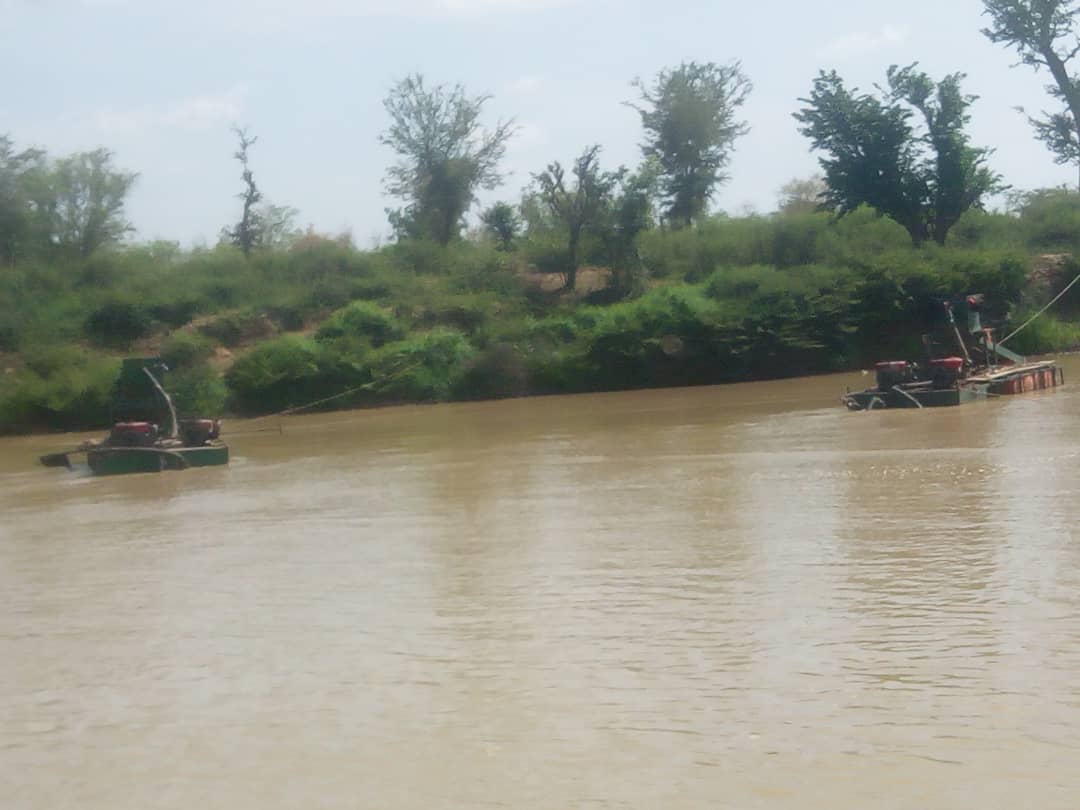
What was once a lifeline for fishing, farming, and cross border trade is rapidly becoming a frontline of lawlessness. Along stretches of the Black Volta in Ghana’s Upper West Region, armed illegal miners are operating with boldness that local authorities describe as unprecedented undermining environmental safety, border security, and confidence in the state’s ability to enforce the law.
A months long investigation by Nii Okpoti Odamtten and Muhammed Faisal Mustapha reveals a sophisticated and deeply troubling pattern of illegal alluvial mining (galamsey) in the Nadowli–Kaleo District, particularly near the riverside community of Saan. Multiple sources allege that many of the miners are foreign nationals, believed to be from neighbouring Burkina Faso, exploiting porous borders and weak enforcement along the river.
Truckloads of mining equipment shamfa machines, fuel drums, pumps, and accessories are allegedly transported into the area under cover of routine movement. Once offloaded, the machines are mounted on makeshift platforms constructed directly on the Black Volta, allowing continuous extraction from the riverbed.
Residents say the operations are conducted in full view of communities that feel powerless to intervene.
“They come in trucks, mount their machines on the river, and mine openly,” a local source told investigators. “When security pressure mounts, they simply cross the river.”
The Black Volta, which doubles as a natural boundary between Ghana and Burkina Faso, has become both a resource and a refuge used by the miners as an escape route whenever Ghanaian authorities move in.
Security sources confirm that whenever intelligence signals an impending operation on the Ghanaian side, miners abandon their equipment and retreat across the river into Burkina Faso, returning days later once enforcement wanes.
“It has become a cat and mouse game,” an official familiar with the operations said.
“They mine on the Ghanaian side, flee when chased, and return when things cool down.”
This cross border dynamic has rendered routine enforcement largely ineffective, exposing gaps in coordination between the two countries and stretching already limited local resources.
“This is no longer just about illegal mining. It is about territorial control, intimidation, and the authority of the state.”
Perhaps most alarming are allegations of direct threats against security personnel.
Investigators were told that a key figure associated with the miners acts as a roaming scout monitoring the movement of security agencies and relaying intelligence in real time.
“He openly said that if any security officer meets them on the Black Volta, they will kill the person,” a community source disclosed.
Such statements have heightened fear among enforcement officers, many of whom are routinely forced to pursue suspects into dangerous waters with little protection or backup.
When intelligence about the operations reached the District Chief Executive (DCE) for Nadowli–Kaleo, Madam Mary Haruna, immigration officers were immediately dispatched to the area. But by the time they arrived, most of the suspects had vanished across the border.
“The officers tried to pick the vehicle, but the people drove off,” a source said.
“Their numbers were not encouraging. It’s not easy.”
During subsequent operations, officers seized mining equipment and motorcycles, but the core networks behind the operations remain intact.
The investigation also uncovered disturbing claims of local collaboration. Authorities recently arrested a traditional leader accused of allowing illegal miners to operate within his jurisdiction.
In another case, a man posing as a fisherman was allegedly harbouring miners along the riverbank. A raid on the location uncovered about 3 motorbikes, two of which were seized, along with an additional shamfa machine and assorted mining tools.
“It’s a headache,” one officer involved in the operation admitted.
“Everywhere you turn, there’s another layer.”
“Every week, we chase them two or three times. They return bolder, more violent, and better organised.”
In an interview, DCE Madam Mary Haruna expressed deep frustration but also outlined a potential path forward one that places local communities at the centre of protection efforts.
She proposed employing young men along the riverbank as water guards, leveraging their familiarity with the terrain and swimming skills to protect the Black Volta.
“If the youth along the Black Volta are employed to protect it, that will empower them and encourage them to defend the river,” she said.
According to her, the approach could provide jobs, build community ownership, and close the intelligence gap that currently favours the miners.
Officials say enforcement efforts are draining scarce public resources, with little lasting impact.
“Our internally generated funds are being sunk into the Black Volta trying to chase and save people,” one source lamented.
“We have shouted and shouted, but to no avail.”
Despite repeated appeals, local authorities say they are yet to receive the reinforcements, equipment, and cross border collaboration needed to dismantle the networks behind the operations.
What is unfolding along the Black Volta is no longer just an environmental emergency. It is a national security concern, playing out quietly along Ghana’s northwestern frontier.
Without urgent intervention stronger border collaboration, decisive political will, and sustained enforcement communities fear the river, and the authority of the state itself, may soon be completely overrun.
Story By: Nii Okpoti Odamtten/Muhammed Faisal Mustapha