

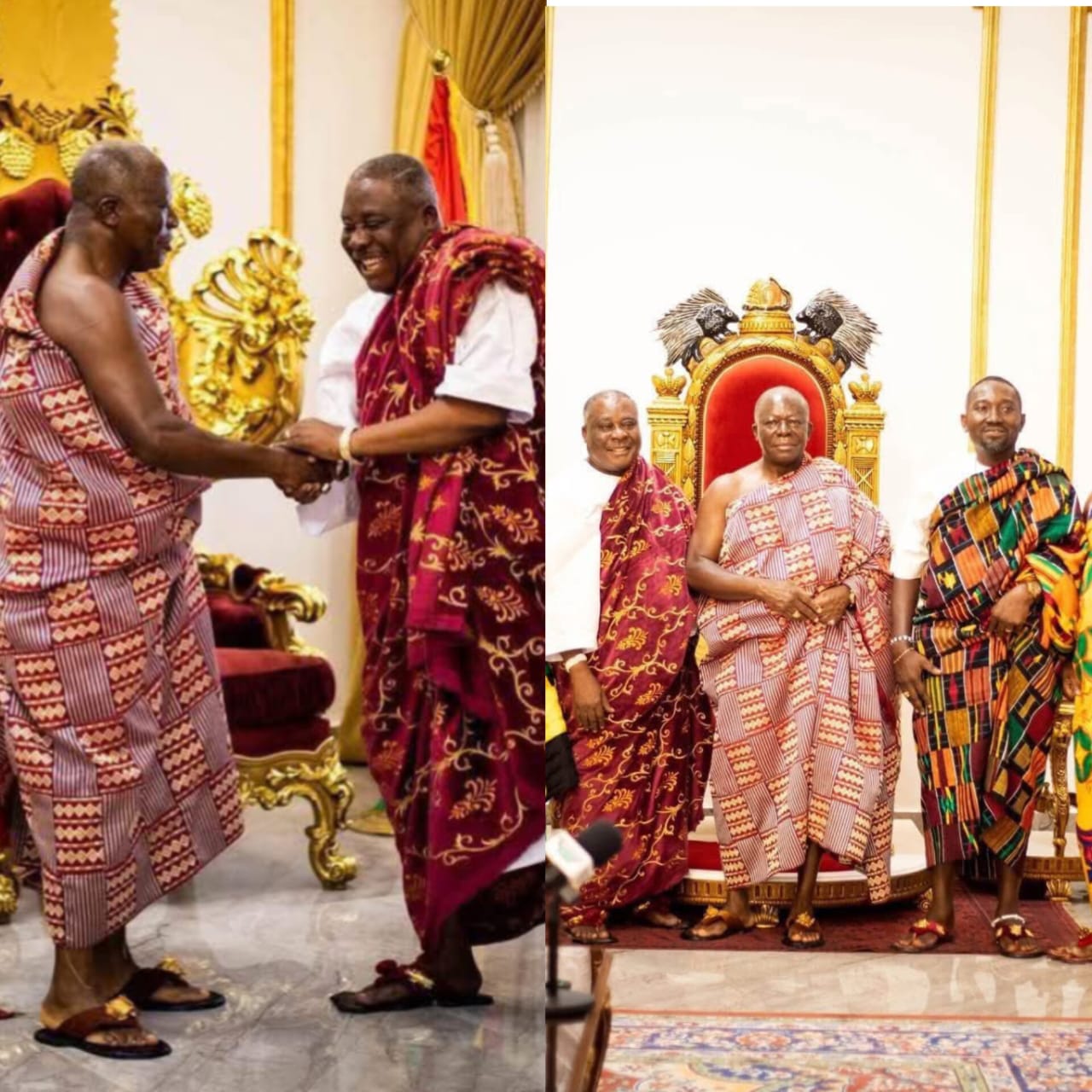
Kingmakers of the Prampram Traditional Area in the greater Accra region, have commended the Asantehene, Otumfuo Osei Tutu II, for what they describe as a principled and courageous decision to reject a request by the Greater Accra Regional House of Chiefs to intervene in ongoing chieftaincy disputes in the region.
The request was made during a courtesy call on the Asantehene by the President and Vice President of the Greater Accra Regional House of Chiefs, King Odaifio Welentsi III and Nene Tetteh Wakah III, who appealed to Otumfuo to help resolve lingering chieftaincy disputes that have become a growing national concern.
According to the visiting chiefs, their appeal was premised on the Asantehene’s widely acknowledged role in mediating protracted traditional conflicts, including the chieftaincy disputes in Yendi and Bawku.
However, Otumfuo Osei Tutu II firmly declined the request, stating that intervening in Greater Accra chieftaincy matters would contradict established traditions and customary structures. He stressed that the Regional House of Chiefs already has the constitutional mandate to resolve such disputes and that his intervention would only be appropriate if all existing mediation mechanisms had been exhausted, a situation he indicated had not yet arisen.
Otumfuo’s stance has since drawn widespread public approval, including from the Prampram Kingmakers, who also launched a scathing critique of the leadership of the Greater Accra Regional House of Chiefs for what they described as an “ill-advised and hypocritical” request.
Speaking to the media, the Prampram Kingmakers questioned the moral authority of King Odaifio Welentsi III to seek external intervention while, in their view, failing to address longstanding chieftaincy disputes in Prampram. They further accused the Regional House leadership of neglecting justice for families of chiefs and elders who were brutally murdered in connection with the dispute.
The Kingmakers particularly questioned why Nene Tetteh Wakah III, who doubles as Vice President of the Regional House of Chiefs and is associated with the Prampram chieftaincy conflict, continues to hold office amid serious controversy. They reiterated their long-held position that Nene Tetteh Wakah does not hail from any of the three royal clan houses customarily mandated to occupy the Prampram stool.
They also raised concerns over what they described as the silence of the Regional House President regarding several chieftaincy-related killings in Prampram. According to them, Nene Tetteh Wakah is currently standing trial, together with eight others, in one of the murder cases linked to the dispute.
The Kingmakers recalled earlier public statements by King Odaifio Welentsi III in which he pledged to help correct chieftaincy wrongs in traditional areas such as Prampram. They questioned why that commitment appears to have waned, especially in light of their claim that Nene Tetteh Wakah’s authority as chief was challenged and dismissed by the National House of Chiefs in 2020, prior to his alleged gazetting.
They further questioned whether the Regional House President’s current posture is influenced by his alleged involvement in signing the Chieftaincy Declaration (CD) Form that enabled Nene Tetteh Wakah’s gazetting, despite the unresolved legal disputes.
The Prampram Kingmakers are now calling on Otumfuo Osei Tutu II to use his moral authority to urge the leadership of the Greater Accra Regional House of Chiefs to ensure a fair, transparent, and impartial hearing of the Prampram chieftaincy dispute.
They have also appealed to President John Dramani Mahama to prevail on the Minister for the Interior and the Attorney-General and Minister for Justice to expedite proceedings in the murder trial at Criminal Court Two of the Accra High Court, where Nene Tetteh Wakah and eight others, including Neizer Osabutey, Richard Shamo Sackey, and Farouk Abbey, are standing trial over the 2021 killing of Nene Otuseikro IV, a case prosecutors say is linked to the protracted Prampram chieftaincy conflict.