

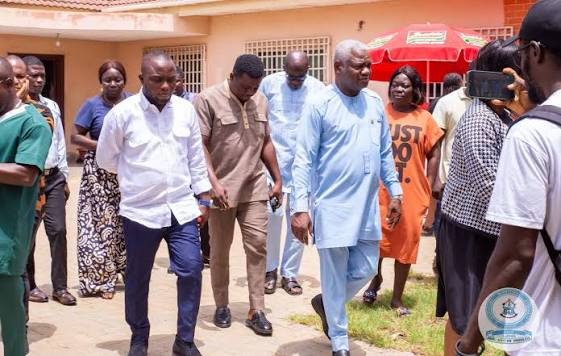
Story By: Nii Okpoti Odamtten / Muhammed Faisal Mustapha…
Along the vibrant eastern coastline of Accra, where fishing communities blend with rapidly expanding urban neighborhoods, the Ledzokuku Municipal Assembly is emerging as a notable example of grassroots governance and community driven development.
At the center of this evolving municipal landscape is Israel Adjetey Otchwenmah, widely known among residents as “Kuzor.” As Municipal Chief Executive (MCE), his administration has placed strong emphasis on infrastructure development, youth empowerment, sanitation improvement, and participatory governance.
Under his leadership, the municipality is pursuing a development strategy aimed at balancing the pressures of rapid urbanization with the needs of long established coastal communities.
“Development must be visible, inclusive, and measurable. Governance should be felt in every neighborhood and by every household in Ledzokuku.”
A central pillar of the administration’s agenda has been the expansion and rehabilitation of critical infrastructure across the municipality.
Communities such as Teshie and Nungua, along with surrounding neighborhoods, have witnessed ongoing road rehabilitation and drainage expansion projects designed to improve mobility and mitigate the persistent flooding challenges that have long affected parts of the coastal belt.
Municipal officials say the objective is not merely to upgrade roads but to strengthen economic connectivity linking residential areas with schools, markets, health facilities, and commercial hubs.
“When roads improve, businesses expand, children reach school safely, and emergency services move faster. Infrastructure is not just concrete; it is opportunity and progress.”
Drainage improvement initiatives are also being implemented as part of broader climate resilience strategies, particularly important for low lying coastal communities increasingly vulnerable to flooding and environmental pressures.
Beyond physical infrastructure, the municipality has prioritized education and youth development as the backbone of sustainable growth.
The assembly has supported classroom rehabilitation projects, distribution of school furniture, and initiatives promoting digital learning in public schools across the municipality.
For the MCE, empowering the youth is central to the long term transformation of the area.
“Our young people represent the future workforce, innovators, and leaders of this municipality. Investing in their education and skills today secures the prosperity of tomorrow.”
In addition, vocational training initiatives and small business incubation programs have been introduced to help young people gain employable skills and pursue entrepreneurship, addressing unemployment while strengthening local economic participation.
As a coastal municipality with dense residential settlements, sanitation remains one of the most pressing challenges for the area.
The municipal administration has therefore intensified waste management partnerships, community clean up campaigns, and public awareness initiatives aimed at improving environmental standards.
These efforts are supported by collaborations between the municipal assembly, private waste contractors, and local community groups.
“Sanitation is a collective responsibility. Government provides leadership, but communities must also take ownership of keeping their environment clean and healthy.”
Public health outreach programs including health screening campaigns and community education initiatives have further strengthened the municipality’s preventive health framework.
Observers note that one of the defining characteristics of the current administration has been its emphasis on inclusive governance.
Traditional authorities, youth organizations, civil society groups, and local associations are increasingly being integrated into municipal planning and decision making processes.
Town hall meetings, stakeholder consultations, and community engagement forums have become key platforms through which residents contribute ideas and voice concerns about local development priorities.
“Leadership is not about governing in isolation. It is about listening to people, working together, and building solutions that reflect the aspirations of the community.”
This participatory approach has helped strengthen public trust while ensuring that development initiatives reflect the needs of the municipality’s diverse population.
With a growing population and vibrant coastal economy, the municipality has also focused on supporting traders, artisans, and small scale enterprises.
Market infrastructure improvements, streamlined licensing procedures, and entrepreneurship support programs are among the initiatives aimed at strengthening the local economic ecosystem.
Municipal leaders believe that empowering small businesses not only stimulates economic activity but also enhances internally generated revenue needed to sustain public services.
Like many urbanizing coastal areas, Ledzokuku continues to face complex challenges ranging from environmental vulnerability to infrastructure demands driven by population growth.
However, municipal authorities remain optimistic that strategic planning, community collaboration, and sustained investment will continue to drive progress.
For many residents, the visible improvements in roads, sanitation systems, schools, and youth initiatives signal the emergence of a municipality steadily redefining its development trajectory.
“Our mission is ongoing,” Hon. Otchwenmah reflects.
“The vision is clear a municipality where opportunity reaches every community and development leaves no one behind.”