

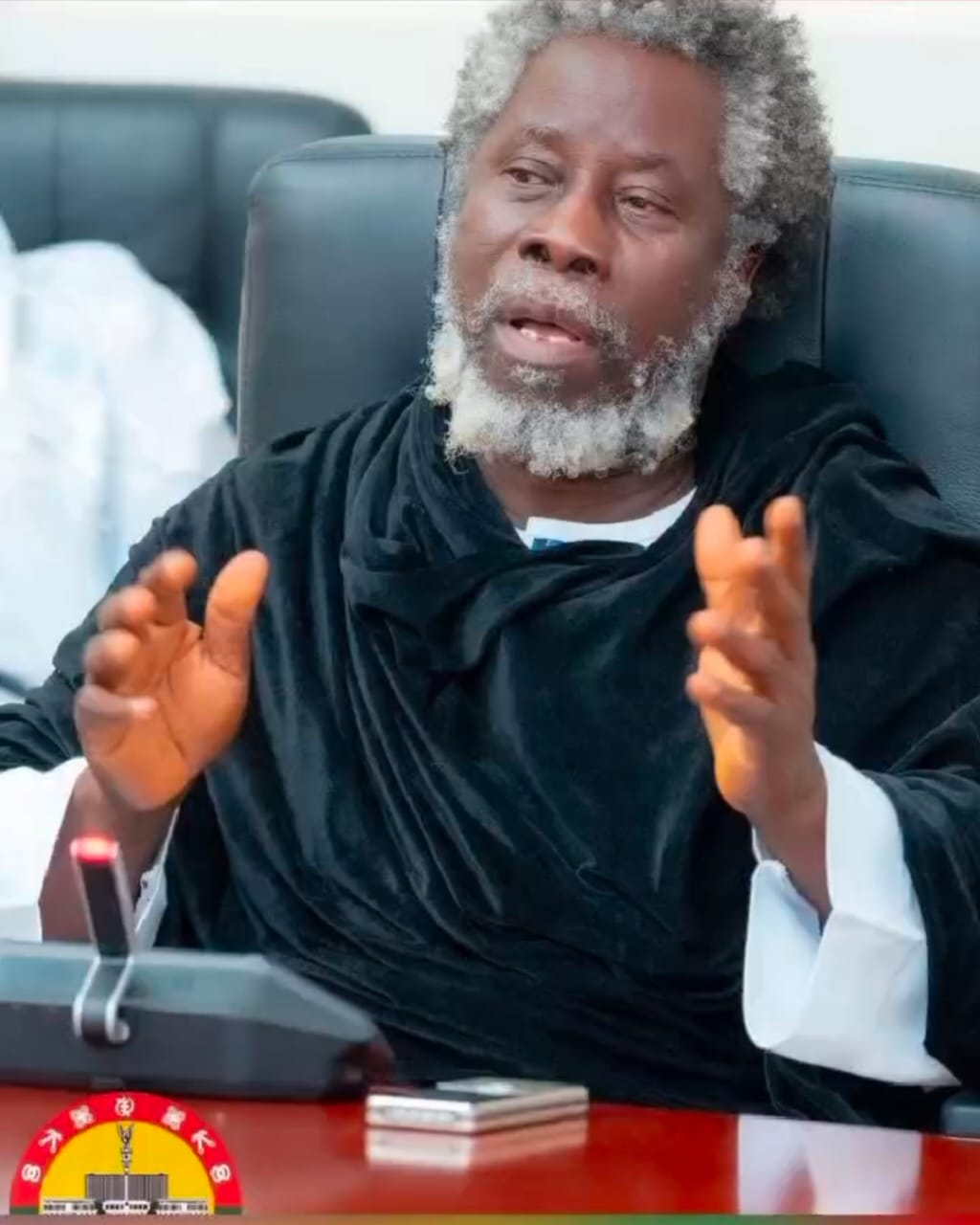
Story By: Nii Okpoti Odamtten / Muhammad Faisal Mustapha
In a message that has stirred debate among religious observers and the wider public, the Founder and Spiritual Leader of Asomdwee Ntontom Som, Okronkronyi Nyame Somafo Yawoh, has attributed Ghana’s ongoing development challenges to what he describes as a “spiritual removal” of the nation’s progress during the colonial era.
Speaking to a gathering of followers at his temple, the spiritual leader claimed that Ghana’s prosperity was spiritually transferred by British colonial forces to the River Tame. According to him, this act continues to have lingering spiritual consequences that affect the country’s ability to advance economically and socially.
His remarks come amid renewed national conversations about development, leadership, and the long term effects of colonial history on African economies.
“Ghana’s progress was not only taken in physical terms during colonial rule,” he said. “It was also removed spiritually, and until that is addressed through prayer and divine intervention, the nation will continue to struggle.”
The spiritual leader’s assertions place Ghana’s development challenges within a metaphysical framework. While economists and political analysts often attribute Ghana’s difficulties to structural economic issues, governance challenges, and global economic pressures, he believes spiritual factors play a decisive role.
According to him, the colonial period did more than extract natural resources it also disrupted what he described as the country’s “spiritual destiny.”
“Britain took everything and left behind social burdens and broken systems,” he claimed.
“That is why our nation finds it difficult to move forward despite its abundant resources.”
To illustrate his point, he used a farming analogy familiar to many Ghanaians.
“Ghana is like a farmer who has refused to sharpen his cutlass yet expects a bumper harvest,” he explained. “Progress will only come when we sharpen our spiritual tools and cast out negative forces.”
In defending his perspective, the spiritual leader cited passages from the Bible, including Book of Isaiah chapters 19:24–25 and 60:22, which he interprets as indicating that Ghana occupies a special spiritual place among nations.
He argued that the country’s natural wealth and strategic position should make it one of the most prosperous nations in the world.
“Ghana is destined to rise,” he declared. “Our blessings should surpass even those of nations like Saudi Arabia and Israel, but spiritual forces have delayed that destiny.”
The leader also made claims about what he described as spiritual disturbances affecting some national landmarks.
He alleged that Independence Square, a symbol of Ghana’s sovereignty and pride, is spiritually occupied by negative forces that hinder national progress.
Similarly, he cited the troubled Komenda Sugar Factory, which has struggled with operational setbacks since its commissioning, as an example of infrastructure facing spiritual opposition.
“If I am allowed to pray on the land where the Komenda Sugar Factory stands,” he said, “the spiritual obstacles will be removed, and the factory will resume full operation.”
Recounting what he described as a personal spiritual encounter, the leader spoke about Nyamrasa Junction, an area previously known for frequent road accidents.
He claimed that through prayer and spiritual confrontation with unseen forces, he was able to neutralize the entity responsible for the accidents.
“I encountered the spirit responsible for the tragedies there,” he told followers. “After the prayers, the accidents stopped. That shows the power of spiritual intervention.”
While such claims cannot be independently verified, they reflect a broader cultural reality in Ghana where spiritual explanations often coexist with scientific and policy based interpretations of events.
The spiritual leader has now called on the Government of Ghana and traditional authorities to grant him permission to undertake what he described as a spiritual mission to recover the country’s lost fortunes.
According to him, this could involve traveling to the United Kingdom to pray near the River Tame, or conducting extended spiritual rituals at his temple.
“We are ready to go wherever necessary to retrieve Ghana’s spiritual inheritance,” he said. “But we need the nation’s leaders to support the process.”
Ghana is widely regarded as one of Africa’s most religious societies, where faith plays a significant role in public discourse. Spiritual leaders across Christian, Islamic, and traditional belief systems frequently comment on national matters, offering moral guidance or prophetic interpretations.
While the claims by Okronkronyi Nyame Somafo Yawoh are likely to provoke debate among theologians, historians, and policy experts, they also highlight the enduring influence of spirituality in shaping public perceptions about national destiny.
For many Ghanaians, development is not viewed solely through economic statistics or political reforms, but also through spiritual wellbeing.
As discussions about Ghana’s future continue, voices from faith communities remain part of the broader conversation about how the nation can unlock its full potential.
“Ghana’s breakthrough will come,” the spiritual leader concluded. “But it will begin when the nation turns back to God and confronts the spiritual forces holding it back.”