

Rabat is pursuing a path of deep transformation, driven by economic, social and institutional reforms, an increasingly assertive diplomacy, and a determination to establish itself as a major regional actor in Africa, the Mediterranean and the Atlantic space.
According to the American think tank the “Stimson Center,” Morocco today appears as one of the most stable and strategically positioned countries in North Africa. At the crossroads of Europe, Africa and the Atlantic world, the Kingdom seeks to consolidate its role as a political, economic, logistical and technological platform. This ambition is based both on far-reaching domestic reforms, an active foreign policy and a modernization strategy focused on high value-added sectors.
On the diplomatic front, Rabat continues to defend the centrality of its autonomy plan for the Sahara, presented as the most realistic basis for achieving a lasting political solution. United Nations Security Council Resolution 2797, adopted at the end of October 2025, established a new negotiating framework centered on the Moroccan plan, with the full and complete participation of Algeria. For Morocco, this development strengthens a favorable diplomatic dynamic, marked in recent years by growing support from several international partners for its autonomy proposal.
This orientation is part of a broader strategy to consolidate Moroccan influence. The Kingdom is strengthening its partnerships with the United States, the European Union, Gulf countries and several African states. In sub-Saharan Africa, it relies on investment, religious cooperation, training, infrastructure, banking, telecommunications and fertilizers to assert its role as a leading economic and political partner.
An economy undergoing transformation, focused on competitiveness
Economically, Morocco is pursuing a strategy of deep modernization, built around the New Development Model, presented in 2021 and designed as a roadmap through 2035. This vision aims to strengthen the competitiveness of the private sector, reduce inequalities, improve education and health systems, consolidate governance and promote job creation, particularly for young people. It also emphasizes the development of high value-added industries and greater involvement of the regions in the growth dynamic.
In the same spirit, Rabat has launched a major social reform aimed at establishing universal social protection, with the expansion of health insurance, the extension of pension coverage to self-employed and informal workers, and the introduction of family allowances. In 2024, nearly 88% of the population already benefited from basic health coverage.
At the same time, Moroccan authorities are pursuing tax and administrative reforms intended to simplify corporate taxation, broaden the tax base, combat the informal sector and accelerate the digitization of tax and customs services. These measures are part of a broader strategy to improve budgetary efficiency, transparency and economic attractiveness.
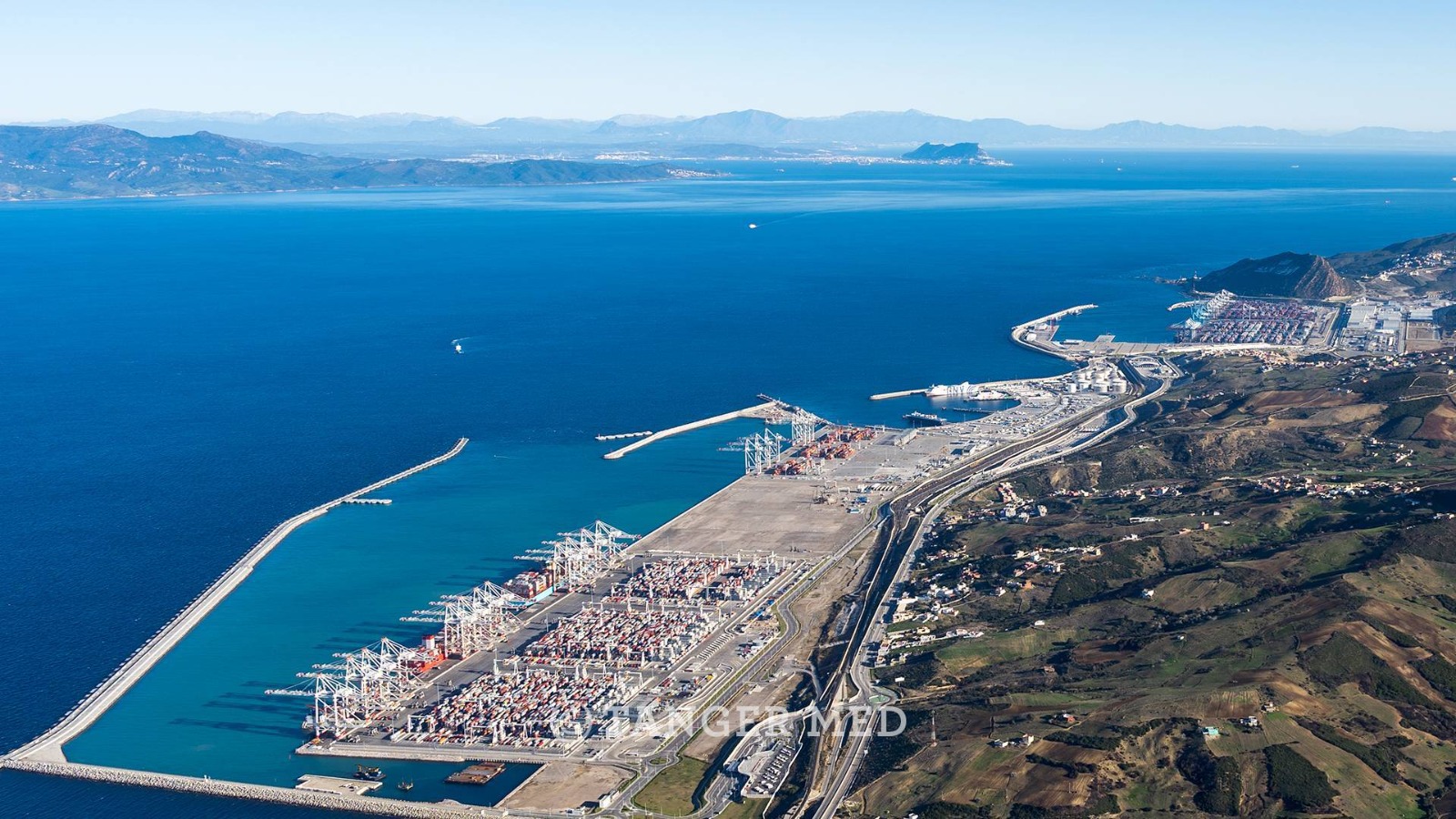
This transformation also relies on massive investments in port, road, rail and digital infrastructure. In this regard, the Tanger Med complex illustrates the Kingdom’s growing logistical strength. Located on the strategic Tanger Med–Algeciras corridor, at the heart of the Strait of Gibraltar, this hub has established itself as the leading container port in Africa and the Mediterranean. In 2024, it handled 10.2 million TEUs, far surpassing Algeciras. Around the port, more than 1,200 companies now operate in sectors such as automotive, aeronautics, textiles and advanced logistics.
Thanks to its maritime connectivity, integrated industrial zones and free trade agreements with the European Union and the United States, Morocco is positioning itself as a major platform for production, industrial relocation and exports to European, African and Atlantic markets. This orientation reinforces the image of a country seeking to combine political stability, economic reforms and deeper integration into global value chains.
Morocco’s bet on artificial intelligence and digital technology
Morocco also intends to make digital technology and artificial intelligence a central lever of its economic transformation. Already considered one of the most advanced digital economies on the African continent, the Kingdom unveiled the Morocco AI 2030 roadmap in January 2026, linked to the Morocco Digital 2030 strategy launched in 2024. This orientation aims to modernize public administration, stimulate private innovation, strengthen national skills in artificial intelligence and reduce dependence on foreign technological solutions.
Through these strategies, Moroccan authorities aim to create around 240,000 digital jobs and generate nearly 10 billion dollars in contribution to GDP by 2030. The planned establishment of the Al Jazari Institutes, designed as a national network of AI centers of excellence, is expected to bring university research closer to economic and regional needs. A General Directorate for AI and Emerging Technologies is also expected to coordinate public policies in this field.
This ambition goes beyond the national framework. In partnership with the United Nations Development Programme, Morocco seeks to promote an Arab-African digital hub, thereby affirming its desire to position itself as a continental reference actor in AI and digital development. At the multilateral level, Rabat has also strengthened its diplomatic profile in technological governance, notably by co-initiating with the United States the first United Nations General Assembly resolution devoted to artificial intelligence, adopted by consensus in March 2024.
These ambitions are supported by a growing digital infrastructure: high internet penetration, mobile development, submarine cable connectivity with Europe and West Africa, as well as an active ecosystem around Casablanca, particularly in service outsourcing, fintech and call centers. The presence of actors such as Maroc Telecom, which operates beyond national borders, also strengthens the country’s regional foothold.
A strengthened geopolitical positioning
The think tank emphasizes that Morocco also seeks to take advantage of its geography. Its access to the Atlantic, proximity to Europe and African anchoring allow it to present itself as a bridge between several strategic spaces. Rabat promotes an economic diplomacy based on connectivity, logistics corridors, energy, infrastructure and South-South cooperation.
This vision is reflected in particular in the importance given to the Atlantic initiative, which aims to provide Sahel countries with access to global markets through Moroccan ports. In a regional context marked by instability in the Sahel and the reshaping of international alliances, Morocco seeks to position itself as an actor of stability, mediation and economic integration.
The report also highlights Morocco’s energy strategy. The Kingdom is presented as one of the regional leaders in solar power, wind power, green hydrogen and the energy transition. The Noor Ouarzazate solar complex is cited as one of the symbols of this ambition.
Thanks to its solar and wind potential, a long-term state vision and its ability to build international partnerships, Morocco intends to become a strategic supplier of green energy to Europe and an important player in new global energy chains.
This orientation is part of a broader strategy: reducing energy dependence, attracting industrial investments linked to clean technologies and positioning itself in future markets, particularly batteries, electric vehicles and green hydrogen.
In conclusion, the “Stimson Center” highlighted the Kingdom’s stability and remarkable progress over the past two decades, thanks in particular to the constitutional monarchy system, economic liberalization, trade agreements and industrial policy, among other factors. It stressed that the Kingdom now possesses the necessary foundations to become one of the most important economies and influential powers on the African continent and in the Mediterranean space in the coming decades.