

Story By: Felix Ernest Odamtten / Muhammad Faisal Mustapha…
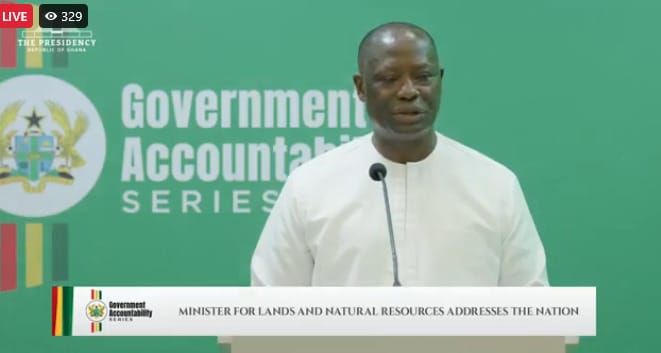
The Minister for Lands and Natural Resources, Hon. Emmanuel Armah-Kofi Buah, has strongly defended the Responsible Cooperative Mining and Skills Development Programme (rCOMSDEP), describing it as a structured pathway towards responsible mining rather than a mechanism for promoting illegal mining, popularly known as galamsey.
Speaking during a government accountability engagement, the Lands Minister said the initiative was developed to provide a regulated and sustainable framework for thousands of Ghanaians who depend on mining activities for their livelihoods.
Hon. Buah explained that Ghana’s mining sector requires practical solutions that recognise the realities on the ground while introducing stronger systems to protect the environment and ensure that mineral resources contribute meaningfully to national development.
“Cooperative mining is not galamsey. It is a responsible mining pathway designed to bring order, training and sustainability into the small-scale mining sector,” the Minister stated.
He noted that mining remains a significant economic activity involving millions of citizens across several regions, making it necessary for government to introduce interventions that promote lawful participation and responsible resource extraction.
“We have a challenge that cannot be ignored. More than three million Ghanaians are engaged in mining activities across different regions, and the solution is not simply to condemn them; the solution is to create a responsible system that works,” he said.
The Minister said rCOMSDEP forms part of a broader government strategy to address illegal mining through a combination of education, stakeholder engagement, institutional reforms, collaboration and improved regulation of the sector.
According to him, the programme seeks to transform the small-scale mining landscape by equipping miners, especially young people, with the knowledge and skills required to operate within environmental and legal standards.
“Mining must not come at the cost of destroying our forests, polluting our rivers or damaging our lands. There is a responsible way to mine, and that is what we are promoting,” Hon. Buah emphasised.
The initiative will place strong emphasis on training and capacity building, with participants expected to gain knowledge in environmentally friendly mining techniques, land restoration and sustainable resource management practices.
The Minister revealed that government’s target includes training thousands of young people under the programme, while ensuring that local communities and traditional authorities play a central role in monitoring and supporting mining activities.
He stressed that community ownership would be essential to the success of the programme, as local involvement would help guarantee accountability, transparency and compliance with responsible mining principles.
Hon. Buah explained that traditional leaders, community representatives and relevant institutions would work together to ensure that mining operations under the cooperative model follow approved guidelines and protect Ghana’s natural resources.
The Lands Minister maintained that rCOMSDEP is not a replacement for the fight against illegal mining but rather a complementary intervention aimed at creating lawful opportunities for people involved in small-scale mining.
He assured Ghanaians that government remains committed to balancing economic empowerment with environmental protection, ensuring that the country’s mineral wealth becomes a foundation for sustainable development.
As Ghana continues its efforts to reform the mining sector, the Responsible Cooperative Mining and Skills Development Programme is being positioned as a major policy intervention aimed at changing the narrative around small-scale mining and building a more responsible future for the industry.