

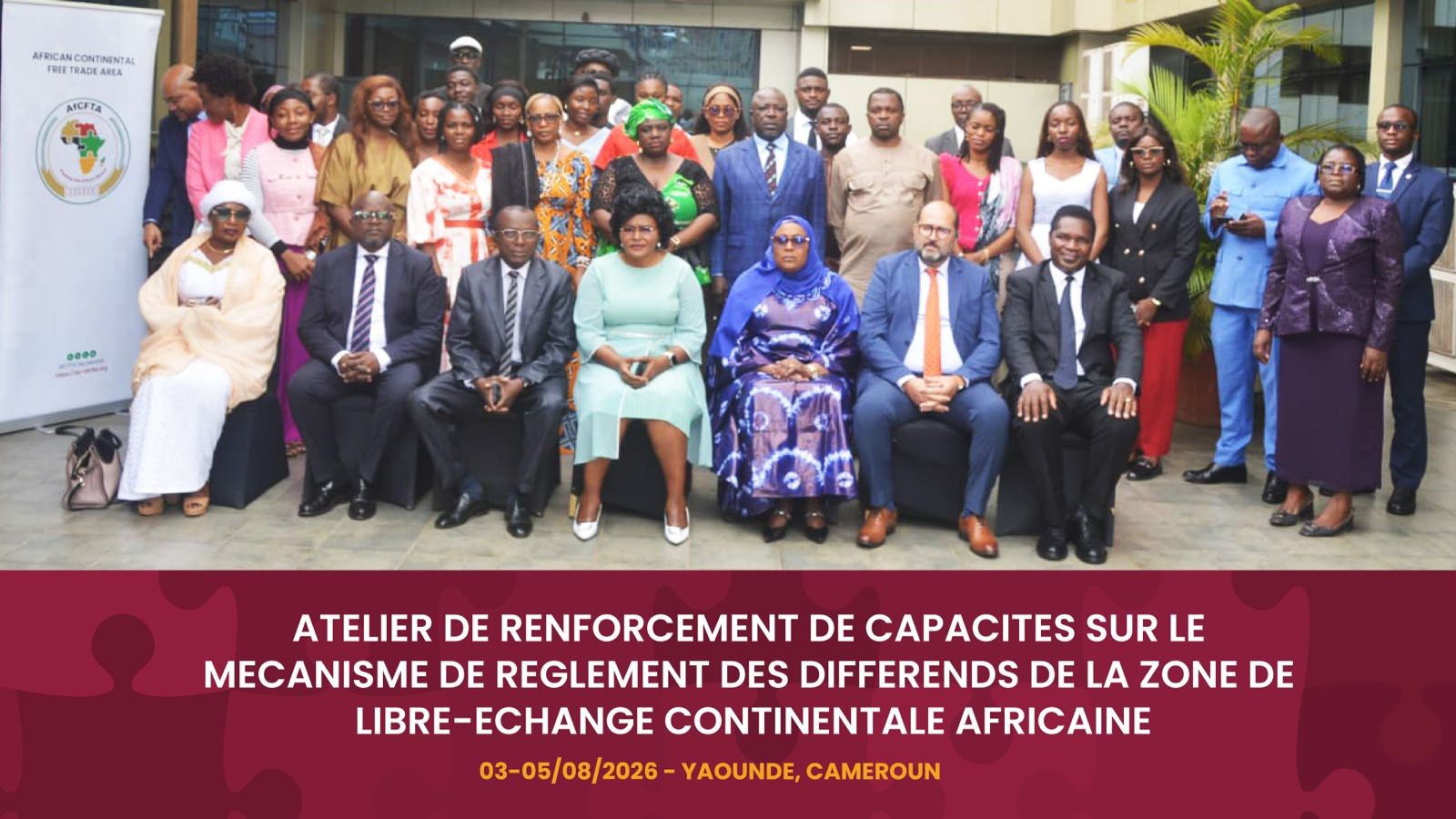
The African Continental Free Trade Area (AfCFTA) is increasingly shifting from the negotiating table to practical implementation, with Cameroon taking another significant step to ensure its businesses are prepared to trade confidently across Africa’s single market.
On Monday, 3 August 2026, stakeholders from both the public and private sectors gathered at Hotel La Falaise in Yaoundé for a three-day capacity-building workshop on the AfCFTA Dispute Settlement Mechanism, an initiative designed to strengthen understanding of the legal framework that underpins Africa’s rapidly expanding continental market.
The workshop, organised under the auspices of the AfCFTA Secretariat and Cameroon’s Ministry of Trade, reflects a growing continental focus on ensuring that the institutions supporting the Agreement are fully operational and accessible to businesses.
Opening the workshop, the Secretary-General of Cameroon’s Ministry of Trade, Professor Brusil Miranda Metou, reaffirmed Cameroon’s longstanding commitment to the AfCFTA, describing the country as one of the pioneers that has supported the Agreement from its conception through to implementation.
She stressed that strengthening stakeholders’ understanding of the Agreement is essential to unlocking the full benefits of the AfCFTA, noting that knowledge of dispute settlement procedures is critical for businesses operating across borders.
According to Professor Metou, the workshop will provide participants with practical knowledge on dispute settlement procedures, arbitration, conciliation and the process of initiating trade-related cases under the Agreement.
She urged participants to actively engage in the discussions, emphasizing that greater legal awareness would help Cameroonian enterprises prevent commercial disputes that could otherwise result in costly financial losses and undermine business confidence.
The opening ceremony was attended by Madam KABO BALKISSOU, Senior Legal Counsel at the Dispute Settlement Body of the AfCFTA Secretariat, whose presence underscored the Secretariat’s commitment to supporting State Parties as they operationalise one of the Agreement’s most important legal institutions.
The training also features presentations from Emmanuel MBARGA, Adviser to the Secretary-General of the AfCFTA Secretariat for Central and North Africa, alongside university lecturers specialising in commercial law and experienced legal practitioners. Beyond lectures, participants are engaging in practical exercises, case discussions and reflections on emerging challenges and future perspectives.
The workshop illustrates how the AfCFTA is evolving beyond tariff negotiations into the practical systems that give businesses confidence to trade across borders. A predictable and credible dispute settlement mechanism is widely regarded as one of the essential pillars of any successful free trade area, providing investors and traders with assurance that commercial disagreements can be resolved fairly, transparently and efficiently.
As Africa accelerates implementation of the AfCFTA, initiatives such as this demonstrate that the continent’s largest free trade agreement is increasingly being measured not only by the treaties signed, but by the institutions being built, the capacities being strengthened and the confidence being created among African businesses to trade under a common set of rules.