

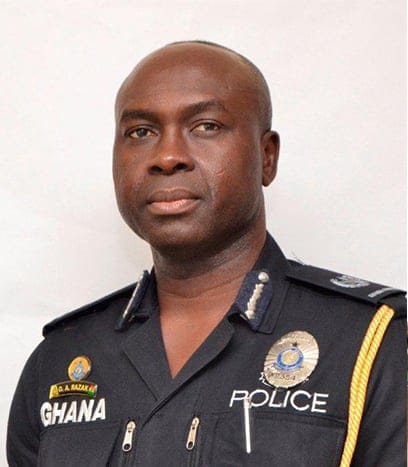
Story By: Muhammed Faisel Mustapha / Felix Ernest Odamtten….
COP Osman Abdul Razak to Lead National Dialogue on Vigilantism and Democratic Security. Ghana’s continuing struggle to eliminate political vigilantism from its democratic landscape came under renewed national scrutiny on Tuesday, August 25, 2026, as Election Watch Ghana convened a high level policy dialogue to assess the implementation of the Vigilantism and Related Offences Act, 2019 (Act 999).
Held at the Kofi Annan International Peacekeeping Training Centre (KAIPTC) in Accra, the dialogue brought together senior security officials, political actors, academics, peacebuilding experts, civil society representatives and other stakeholders to confront a question that has remained politically sensitive since the legislation was enacted: has Ghana truly defeated political vigilantism, or has it merely forced the phenomenon to become less visible?
The National Security Coordinator, COP Osman Abdul Razak, served as Guest Speaker at the event, which was held under the theme, “Assessing the Implementation of the Vigilantism and Related Offences Act, 2019 (Act 999) and Its Implications for National Security and Democratic Governance.” The discussions focused heavily on enforcement, prevention, intelligence, political accountability and the evolving methods used by groups associated with political violence.
The event was chaired by the Chief of Staff, Dr Julius Debrah, while the National Chief Imam, His Eminence Sheikh Osman Nuhu Sharubutu, attended as Special Guest of Honour. Renowned broadcaster Umaru Sanda Amadu moderated the proceedings, which were structured around two major sessions examining the strategic and practical dimensions of Act 999.
The first session featured experienced voices from Ghana’s political and security establishment, including former Minister for Information Kofi Totobi Quakyi, former National Security Minister Francis Poku, Professor George Meyiri Bob Milliar and security and defence analyst Colonel Festus Aboagye (Rtd). Their combined experience provided a broad perspective on the political, institutional and security dimensions of vigilantism.
The second session brought together experts and senior personalities associated with national security, peacebuilding and governance, including former National Security Minister Albert Kan-Dapaah, Dr Benjamin Kumbour, COP Emmanuel Teye Cudjoe and representatives of the National Peace Council. The discussions sought to move beyond political rhetoric towards practical questions of implementation and institutional responsibility.
At the heart of the dialogue was an uncomfortable reality: although Act 999 has significantly reduced the open display of organised political vigilante groups, the disappearance of uniforms, names and visible command structures does not necessarily mean that the networks themselves have disappeared.
COP Abdul Razak warned precisely against such complacency. He disclosed that some groups were allegedly rebranding themselves as internal security teams, volunteer task forces or community security initiatives, while others were moving into less visible networks that could be considerably more difficult for security agencies to identify and monitor.
“We must not mistake reduced visibility of these groups as complete eradication.” COP Osman Abdul Razak
The National Security Coordinator also pointed to a new dimension of the threat: technology. According to him, mobilisation associated with political vigilantism is increasingly capable of moving through social media, encrypted communication channels, local disputes, private security arrangements and other informal networks.
That shift presents Ghana’s security institutions with a different challenge from the one they confronted when vigilante groups operated publicly in identifiable formations. The modern threat, if it develops, could be fragmented, decentralised and digitally coordinated, requiring intelligence led policing and stronger cooperation among security agencies.
COP Abdul Razak therefore argued for a preventive rather than purely reactive security model. His warning was particularly significant because the country is already looking ahead to the 2028 general elections, with the National Security Secretariat reporting early signs of mobilisation that could potentially be exploited for political violence.
His message was unequivocal: security agencies cannot wait until political campaigns and mass rallies are in full swing before beginning serious preventive work. By then, he argued, the security architecture risks moving from prevention to containment a much more difficult and costly position.
“It is easier to prevent political violence before the main event.” COP Osman Abdul Razak
COP Abdul Razak proposed a phased preventive approach in which intelligence mapping and stakeholder engagement begin between 12 and 18 months before elections, followed by youth engagement and civic education between nine and 12 months before polling, and active monitoring of political mobilisation at least six months before elections.
The emphasis on early intervention reflects a broader shift in modern security thinking: political violence should be treated as a process that can be detected and disrupted before it reaches the streets, rather than as an unavoidable consequence of heated elections.
Yet enforcement remains one of the most difficult questions surrounding Act 999. COP Abdul Razak acknowledged that prosecutions under the law have been limited and that legal processes have sometimes been slow, raising concerns about whether delays can weaken the legislation’s deterrent effect.
He nevertheless maintained that the law remains in force and must be applied fairly and consistently. For the National Security Coordinator, the credibility of Act 999 depends not only on what it prohibits but also on how impartially and professionally those prohibitions are enforced.
He warned that enforcement perceived as selective or politically tilted could damage public confidence and undermine the very deterrence the legislation was designed to provide. Security decisions, he said, should be guided by intelligence assessments, evidence and professional judgement rather than political considerations.
“Enforcement should never be perceived as favouring one group over the other.” COP Osman Abdul Razak
The challenge is therefore bigger than the police or the national security apparatus. Political parties, political leaders, state institutions, civil society organisations and citizens all have a role to play in ensuring that political competition does not create space for private armies, intimidation or organised violence.
Professor George Meyiri Bob Milliar brought another dimension to the debate, arguing that political considerations themselves have contributed to difficulties in enforcing Act 999. He suggested that political parties may be reluctant to support vigorous prosecution where their own members or supporters could become targets of the law.
That observation exposes one of the central dilemmas surrounding political vigilantism: a law can prohibit violent political organisation, but its effectiveness ultimately depends on the willingness of political institutions to accept accountability when members cross the legal line.
Act 999 was enacted to prohibit political vigilante groups and related activities, including the creation, organisation and support of groups capable of threatening public safety and democratic stability. Its passage was intended to establish a stronger legal barrier against the use of organised political force in Ghana’s electoral politics.
Seven years after its enactment, however, Election Watch Ghana’s decision to convene the dialogue demonstrates that the national conversation is far from finished. The issue is no longer simply whether Ghana has a law against vigilantism, but whether the law is being enforced sufficiently, consistently and independently to produce the deterrent effect Parliament intended.
The dialogue also placed democratic governance at the centre of the security debate. Political vigilantism does not only create a threat of physical violence; it can intimidate voters, discourage political participation, undermine confidence in elections and weaken the principle that political power must be obtained through ballots rather than coercion.
For Ghana, whose democratic reputation has been built over decades of competitive multiparty elections and peaceful transfers of power, the stakes are significant. Any return to organised political violence whether in visible formations or through covert and digitally coordinated networks would pose a direct challenge to public confidence in the country’s democratic institutions.
The national security perspective presented by COP Abdul Razak therefore points towards a three part strategy: stronger intelligence, earlier intervention and impartial enforcement. Security agencies must identify emerging threats before they become crises, while political actors must demonstrate that electoral competition does not excuse violence and that no individual or group is beyond the reach of the law.
Ultimately, Act 999 will be judged not by the strength of its language but by what happens when the law encounters political power. If enforcement is consistent evidence based and insulated from partisan influence, the legislation can become a credible instrument for protecting democratic space. If enforcement remains selective or delayed, the law risks becoming a symbol rather than an effective deterrent.
The Election Watch Ghana dialogue has consequently reopened one of Ghana’s most important national security conversations at a critical moment. As the country looks towards future elections, the message from the security establishment is increasingly clear: political vigilantism must not be allowed to reinvent itself in the shadows. Ghana’s democratic future will depend not only on peaceful elections, but on the willingness of political leaders, security institutions and citizens alike to ensure that political competition remains a contest of ideas, policies and votes not intimidation, organised violence or fear.