

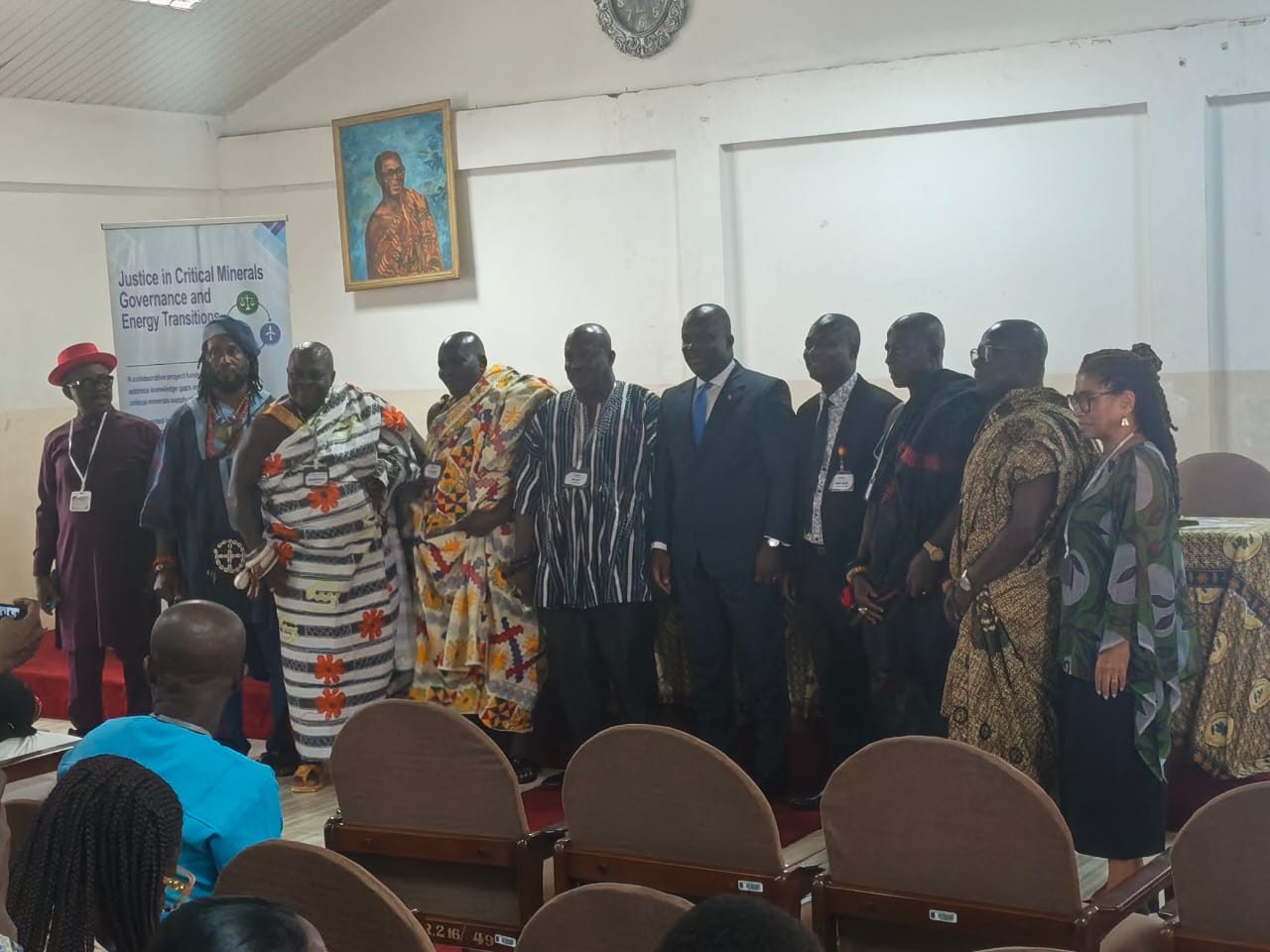
Accra played host this week to the launch of the Ghana component of a major research project on justice in critical minerals governance and the energy transition, bringing together government officials, academics and civil society to interrogate how fairness can be built into Africa’s growing role in the global clean energy supply chain.
Delivering the keynote Member of Parliament for the Damongo Constituency and Former Minister for Lands and Natural Resources, Hon. Samuel Abu Jinapor argued that critical minerals including cobalt, lithium, manganese and rare earth elements, have become indispensable to the technologies underpinning the energy transition, from electric vehicles and battery storage to solar panels and wind turbines.
He noted the International Energy Agency’s projection that demand for critical minerals could triple by 2030 and quadruple by 2040 if the world is to meet net-zero targets, and pointed out that Africa sits at the centre of this demand: the Democratic Republic of Congo alone holds over half of the world’s cobalt reserves, while Zambia leads in copper and countries including Ghana, Zimbabwe, Namibia, Mali, Mozambique, Madagascar and Tanzania hold significant lithium, graphite and manganese deposits.
According to him, the discourse on justice in critical minerals must operate simultaneously on three levels: justice between nations, justice between states and communities, and justice between present and future generations.
Justice between nations.
Jinapor warned against the energy transition becoming “another form of resource exploitation,” noting that African countries endowed with critical minerals often capture only a fraction of the value their resources generate.
He cited estimates that while the global lithium mining industry is worth around $11 billion, the industry’s value at the highest end of the value chain exceeds $7 trillion — with African producer countries capturing only a small share, often cited at 10 to 15 percent.
He pointed to Ghana’s own experience with bauxite and aluminium, where the country exports raw bauxite and imports refined alumina for smelting, as a cautionary tale.
To avoid repeating this pattern with lithium, Jinapor said Ghana’s Cabinet approved a green minerals policy setting a minimum royalty rate of 7 percent, a minimum of 30 percent state and Ghanaian participation in green minerals operations, and requirements for local content, local listing on the Ghana stock exchange, and value addition.
He noted that Ghana’s first lithium mining lease was signed on a 10 percent royalty rate, with government also pushing for the establishment of a domestic refinery, a first for the country.
He also referenced the African Union’s African Green Minerals Strategy, adopted in 2025, and urged African countries to adopt a common negotiating position through the African Continental Free Trade Area, whose secretariat is based in Accra.
Justice between states and communities.
Drawing on his experience as a former minister, Jinapor said communities affected by mining should not be treated merely as “stakeholders” in the abstract, but recognised as the people who bear the direct environmental and social costs of extraction.
He cited a Human Rights Watch report finding that mining activity in Guinea had polluted or diminished water sources across dozens of communities, and said similar water and land degradation patterns are found in Ghana.
As minister, he said, government negotiated an agreement with the Atlantic Lithium Ewoyaa project under which 1 percent of gross production is set aside for a community development fund for communities affected by mining.
Justice between generations.
Jinapor closed by stressing that because critical minerals are finite, their exploitation must benefit not only the current generation but generations to come, invoking Principle 2 of the Stockholm Declaration on safeguarding natural resources for present and future generations.
He argued that the true measure of success should not be tonnes extracted or export revenue recorded, but whether mineral wealth is converted into lasting assets; infrastructure, education and technological capacity that outlast the minerals themselves.
Jinapor closed by thanking UK Research and Innovation and project partners King’s College London and the Institute of African Studies, University of Ghana, for their role in the initiative.
Academic and Government Voices
Samuel Ntewusu, Director of the Institute of African Studies at the University of Ghana, framed the project around four institutional objectives for the research going forward: examining how existing policy frameworks shape collective outcomes; addressing the tension between centralised national policy and local realities; building regulatory institutions resilient enough to prioritise ecological sustainability and human rights beyond short-term political cycles; and moving discussions beyond diagnosis toward concrete recommendations for accountability and reform.
Josephine Badoo, Director of Research at the Ministry of Lands and Natural Resources, also addressed the gathering as part of the launch proceedings.
According to her Ghana must adopt a mineral governance framework that balances economic growth and investment with environmental protection, community participation and long-term sustainability.
Josephine Badoo, said the country’s transition towards green and critical minerals must not result in another cycle of dependence on the export of raw materials.
She said Ghana’s commitment to responsible mineral development was supported by its ratification of major international environmental agreements, including the Paris Agreement and the Vienna Convention for the Protection of the Ozone Layer.
She said Ghana had also developed policy measures to position the country to benefit more from emerging opportunities in the global green minerals industry.
According to her, the government’s emerging green minerals policy framework is focused on maximising mineral revenues, promoting value addition, increasing local content and strengthening state participation in the sector.
She identified the Minerals Commission as the principal government agency responsible for developing and coordinating policies for the mineral sector and monitoring their implementation.
Ms Badoo also pointed to the Ghana Integrated Aluminium Development Programme and the Integrated Iron and Steel Development Programme as important initiatives aimed at building domestic value chains around Ghana’s mineral resources.
She said the programmes were intended to accelerate industrialisation by using Ghana’s mineral resources as catalysts for economic transformation and shared prosperity.
“Ghana must therefore pursue a mineral governance framework that balances investments and economic growth with environmental protection, community participation, transparency, and intergenerational equity,” she said.
Critical minerals and the energy transition
The discussions also highlighted the growing importance of critical minerals such as lithium, graphite and cobalt to the global transition from fossil-fuel-based technologies to cleaner energy systems.
Speakers noted that the global push towards electric vehicles, solar panels, wind turbines and other energy-efficient technologies would increase demand for minerals required to manufacture these technologies.
They stressed that Ghana must therefore take advantage of the emerging critical minerals market while ensuring that mining does not undermine environmental and social objectives.
While governments may focus on economic stability and managing the transition from fossil fuels to clean technologies, communities are more likely to view justice through the lens of environmental protection, livelihoods and social welfare.
Communities must benefit
The discussions further raised concerns about the limited involvement of mining communities in conversations surrounding critical minerals and sustainable mining.
Communities must have a stronger voice in decisions affecting the development of mineral resources in their areas and that sustainable mining should remain at the centre of discussions on critical minerals, particularly as Ghana seeks to attract investment into the sector.
The discussions advocated for an approach that combines mineral development with responsible environmental stewardship, economic value addition and meaningful community participation.
Such an approach, they averred, would help Ghana position its mineral resources as a foundation for industrialisation rather than perpetuating the traditional model of exporting raw materials with limited domestic value addition.
The project’s Ghana launch marks the formal start of in-country research expected to examine mining, community and policy dynamics through both formal governance channels and informal cultural expression — including music, film and community art — as part of a broader effort to capture how justice in the critical minerals economy is understood at national, local and community levels.