

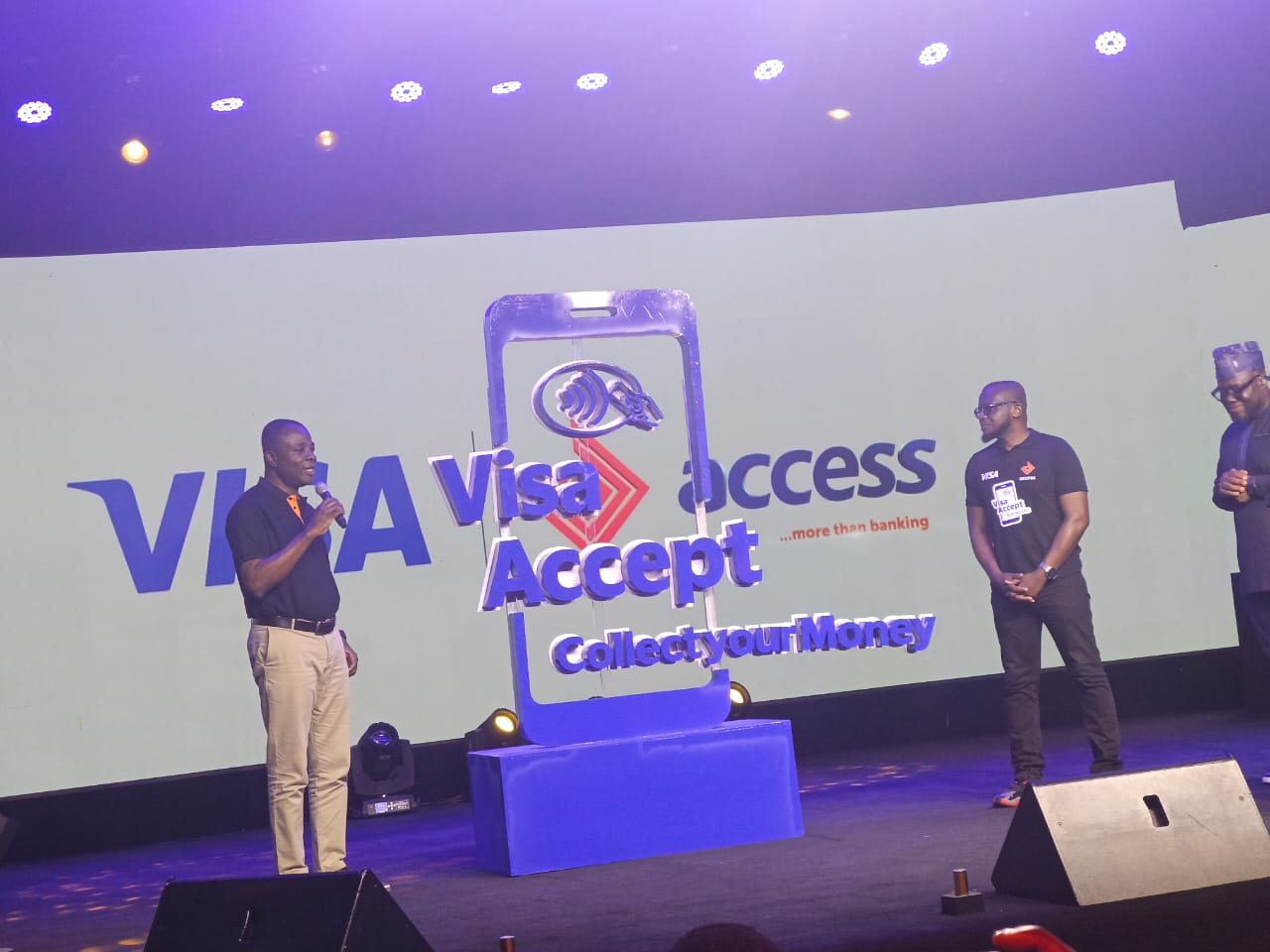
Access Bank Ghana, in partnership with Visa, has launched Visa Accept, a smartphone-based payment solution designed to enable nano and small businesses to accept contactless card payments without the need for a traditional point-of-sale (POS) terminal.
The initiative, according to the two financial institutions, is aimed at addressing one of the major barriers facing small businesses in Ghana’s transition into the formal and digital economy: access to affordable and convenient payment acceptance infrastructure.
Visa Accept effectively turns a merchant’s smartphone into a payment acceptance device, allowing customers to make contactless card payments directly to a business through the Access Bank mobile application.
The launch positions Ghana as the first market for Visa Accept in the Central and Eastern Europe, Middle East and Africa (CEMEA) region, according to Visa Ghana Country Manager, Fabrice Konan.
Smartphone replaces traditional POS terminal
Under the new arrangement, merchants with an eligible Access Bank business account can access Visa Accept through the bank’s mobile application.
Unlike conventional POS systems, the solution does not require merchants to acquire or maintain a separate payment terminal.
A customer simply taps a contactless-enabled payment card or compatible device on the merchant’s smartphone to complete the transaction, subject to the applicable requirements of the service.
Access Bank said the approach was deliberately designed around the realities of Ghana’s large population of small and informal businesses, many of which may find traditional POS infrastructure costly or cumbersome.
The bank described Visa Accept as a “virtual POS” embedded within its mobile application, eliminating the need for an additional device or separate platform.
“Traditional POS terminals carry charges for the merchant, often passed on to the customer. We did not set out to offer a cheaper terminal. We removed the need for one,” an Access Bank representative said at the launch.
The bank argued that Ghana’s widespread use of smartphones makes the solution particularly suited to small merchants who already rely heavily on mobile technology in their daily operations.
Focus on nano and small businesses
A major focus of the initiative is Ghana’s large base of nano and small businesses, including market traders, food vendors, shop owners, service providers and other everyday entrepreneurs.
Access Bank said the challenge goes beyond merely providing another payment channel.
According to the Executive Director, Retail, SME & Digital Banking at Access Bank Ghana, Eugene Ocansey, many small businesses struggle to access formal credit because they lack verifiable records showing the scale and consistency of their business activities.
The digital payment system is expected to help address that problem by creating a transaction trail that can provide businesses and financial institutions with greater visibility into their cash flows.
He explained during the launch that when a small merchant receives payments digitally, the resulting transaction history can help demonstrate the volume and pattern of the business’s activities.
This, he said, could contribute to making some previously informal businesses more visible and potentially more capable of engaging with formal financial services.
“Once you give them a tool that can bring their money and everybody can see what they do, now we can afford to offer them credit,” the Eugene Ocansey said.
He added that the objective was to help make the average small business more “bankable” by providing clearer information about its cash flow.
The initiative therefore links digital payment acceptance with a broader financial-inclusion agenda: helping small enterprises move from predominantly cash-based transactions towards systems that can generate records of their commercial activities.
House-to-house, shop-to-shop rollout
Access Bank also signalled an aggressive campaign to drive adoption among Ghana’s small-business community.
The bank said it intends to take the solution directly to potential users through a broad-based merchant engagement strategy.
The approach was described as a “house-to-house, street-by-street, shop-by-shop campaign”, reflecting the bank’s intention to move beyond conventional banking channels to reach informal businesses across communities.
The strategy is particularly significant because many of the businesses targeted by the initiative operate outside conventional corporate and banking structures.
By taking the technology directly to traders, vendors, shop owners and other small entrepreneurs, Access Bank hopes to expand digital payment acceptance at the grassroots level.
Visa: Solving a real problem for merchants
For Visa, the launch is not simply another technology rollout but an attempt to address a specific gap between consumers who are ready to pay digitally and merchants who may not have the infrastructure to accept those payments.
Mr Konan said the problem was evident in everyday commercial transactions where a potential customer may want to pay by card but a merchant is unable to accept the preferred payment method.
“Every day, there’s a client who is ready to buy. And there’s a merchant who is ready to sell. But the sale doesn’t happen because the merchant is not offering to the client the way he wants to pay,” he said.
He described Visa Accept as an attempt to bridge that disconnect by using a device that merchants already possess.
According to him, traditional card acceptance has historically depended on dedicated payment equipment, which could be impractical for smaller businesses.
Visa Accept, he said, changes that model by allowing the merchant’s smartphone to serve as the payment acceptance device.
“No additional hardware, no complicated setup, a simple way to access payments,” Mr Konan said.
He said the technology could potentially help merchants capture sales that might otherwise be lost because customers do not have cash or prefer to use contactless payment methods.
Ghana first Visa Accept market in CEMEA
Mr Konan disclosed that Ghana is the first Visa Accept market in the Central and Eastern Europe, Middle East and Africa region.
He attributed the decision to the partnership with Access Bank, the identified needs of Ghanaian merchants and the opportunity to expand digital payment acceptance.
He said Visa’s philosophy was that innovation should solve an identifiable problem rather than being introduced merely because the technology exists.
“At Visa, we believe innovation has value only when it solves a problem. We don’t innovate for innovation. We have to solve a problem,” he said.
He described the launch as the beginning of a longer-term process rather than the conclusion of a product rollout.
‘Today is not the finish line’
Mr Konan cautioned that the success of Visa Accept would ultimately depend on how widely and consistently merchants use it.
He said simply launching the product and celebrating the event would not be sufficient.
“Today is not the finish line. Today is the starting point,” he said.
Visa, he explained, intends to work with Access Bank on merchant education, onboarding, facilitating first transactions and encouraging continued usage.
The institutions also intend to monitor active and repeat usage as key indicators of whether the solution is delivering its intended impact.
According to Mr Konan, success should be measured by whether merchants are actually using Visa Accept to sell more, serve more customers and expand their businesses.
“If we don’t deliver on that, it’s zero. Nothing is done,” he said.
No separate POS device
One of the central selling points of Visa Accept is the elimination of a traditional POS terminal.
For small businesses, the cost of acquiring, maintaining and operating dedicated payment equipment can represent an additional burden.
Access Bank said its objective was therefore not to compete by simply offering a cheaper POS machine, but to remove the need for the machine altogether.
The merchant uses a smartphone already in their possession, while the payment functionality is integrated into the Access Bank mobile application.
The bank also said customers who are not already using its mobile application can onboard themselves digitally without necessarily having to visit a branch.
Bringing informal businesses into the formal economy
The launch comes amid continued efforts to increase financial inclusion and bring more economic activity into formal financial channels.
For Ghana’s large population of small businesses, digital payment acceptance can provide benefits beyond convenience.
Regular electronic transactions can create records of sales, improve visibility into cash flow and potentially give financial institutions more information when assessing businesses for financial products.
Access Bank believes this could help address the longstanding challenge of small enterprises having limited documentation to demonstrate their financial performance.
The bank therefore sees Visa Accept not merely as a payment product but as part of a broader effort to create an ecosystem in which small businesses can become more visible to the formal financial system.
‘Your phone is your business’
Visa’s Mr Konan said the ultimate objective was to make participation in the digital economy accessible to entrepreneurs regardless of the size of their operations.
He said Visa and Access Bank would continue investing in solutions designed to make digital payments safer, simpler and more accessible.
The initiative, he added, is intended to serve a wide range of entrepreneurs, from market traders and food vendors to shop owners and service providers.
“When small businesses grow, communities grow, and economies grow,” he said.
He concluded by framing the smartphone as more than a communication device for the small-business owner.
“With this Accept, your phone is your business. Your phone is your opportunity,” Mr Konan said.
The launch represents a further step in the expansion of digital payment acceptance in Ghana, with Access Bank and Visa now turning their attention from introducing the technology to achieving widespread merchant adoption and sustained usage across the country’s small-business sector.