

Government, organised labour and the private sector engaged in three days. Somalia is to deposit its instrument of ratification on 2 September.
The Secretary-General of the AfCFTA Secretariat, H.E. Wamkele Mene, has concluded a three-day official visit to the Federal Republic of Somalia, undertaken at the invitation of the Federal Government as Somalia prepares to deposit its instrument of ratification of the Agreement Establishing the African Continental Free Trade Area with the African Union.
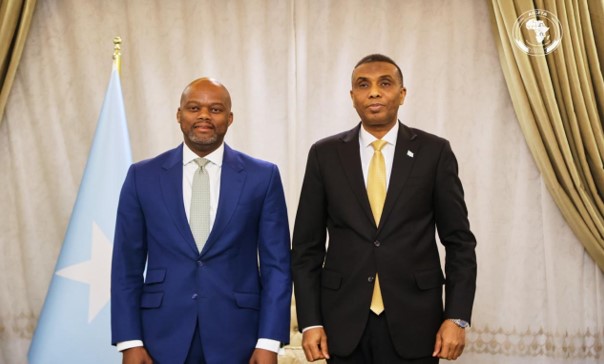
During the visit, the Secretary-General was received by H.E. Hamza Abdi Barre, Prime Minister of the Federal Republic of Somalia. During their meeting, H.E. Mene reaffirmed the Secretariat’s commitment to accompany Somalia through the technical preparations for effective implementation of the Agreement.
He also held discussions with H.E. Amb. Gamal Mohamed Hassan, Minister of Commerce and Industry, and with H.E. Abdisalam Abdi Ali, Minister of Foreign Affairs and International Cooperation.
The delegation further engaged with the Federation of Somali Trade Unions and concluded the visit with a private sector dialogue involving Somali enterprises, the Somali Chamber of Commerce and Industry and the Somali Manufacturers Association.
Moving from ratification to implementation
Discussions with the Ministry of Commerce and Industry focused on the practical steps required to move from ratification to implementation, including tariff schedules, rules of origin, and the customs procedures required for Somali consignments to be recognised as originating in Somalia when entering other African markets.
The Secretariat outlined the instruments available to support the process, including the Pan-African Payment and Settlement System (PAPSS), the AfCFTA electronic tariff book and the AfCFTA Adjustment Fund.
The two sides also discussed joint work on Somalia’s national AfCFTA implementation strategy and the identification of priority export sectors in which the country already has a competitive base.
“Our business people are eager, and they are right to be. They want to see the fruits. We need to move faster, and to make sure that they see results. Five East African countries have already submitted their schedules. I would like Somalia to be the sixth.”
— H.E. Amb. Gamal Mohamed Hassan, Minister of Commerce and Industry, 17 August.
Somalia is not starting this process from scratch. As a Partner State of the East African Community, the country can build on the Community’s consolidated schedule of tariff concessions for the 90 per cent category, while the remaining 10 per cent is being finalised within the Community.
A national strategy for the Agreement was validated in Mogadishu in November 2023, and a national implementation committee is already in place, with organised labour represented among its members.
Private sector identifies priorities
The private sector dialogue held on August 18 brought together the Somali Chamber of Commerce and Industry, the Somali Manufacturers Association and invited enterprises for a practical discussion on what Somali businesses need to trade effectively under the AfCFTA.
The Chamber identified five priority areas for technical assistance:
- Guidance on the steps following ratification.
- Support to priority export sectors.
- Access to opportunities in services sectors, including telecommunications, logistics, finance and digital commerce.
- Establishment of a permanent mechanism for engagement between the Chamber and the Secretariat.
- Practical information on the instruments available to businesses.
The Secretariat undertook to work with Somalia towards the country’s first consignment under the AfCFTA and demonstrating the process from end to end.
“Somalis are natural traders. Trade is already in your DNA. What this Agreement gives you is a market beyond your own region: West Africa, Central Africa, Southern Africa and North Africa.”
Roadmap to Somalia’s first AfCFTA shipment
The Secretary-General outlined the sequence required to move from ratification to Somalia’s first shipment under the Agreement:
- Deposit of the instrument of ratification;
- Domestication of the AfCFTA electronic tariff book;
- Configuration of the applicable preferential tariffs by the customs administration; and
- Completion, within the East African Community, of the outstanding tariff concessions and commitments on trade in services.
“Somali businesses are ready. What they need is certainty, affordable finance and functioning infrastructure.”
Somalia set to become 50th State Party
Upon deposit of its instrument of ratification with the Chairperson of the African Union Commission, Somalia will become the 50th State Party to the Agreement establishing the African Continental Free Trade Area.
At the conclusion of the visit, the Ministry of Commerce and Industry indicated that Somalia intends to proceed with the deposit of its instrument of ratification in September 2026.
The press release concludes that:
“Three days in Somalia have taken the Agreement from a legal act to a work programme.”
The African Continental Free Trade Area (AfCFTA) is one of the flagship projects of Agenda 2063: The Africa We Want, the African Union’s long-term development strategy.
The Agreement establishing the AfCFTA entered into force on 30 May 2019 and brings together the 55 Member States of the African Union in a single market of about 1.4 billion people, with a combined GDP of approximately US$3.4 trillion.
The AfCFTA is described in the document as the largest free trade area in the world by number of participating countries.
The AfCFTA Secretariat is based in Accra, Ghana, and is led by Secretary-General H.E. Wamkele Mene. It coordinates implementation of the Agreement in cooperation with State Parties, Regional Economic Communities and continental institutions.