

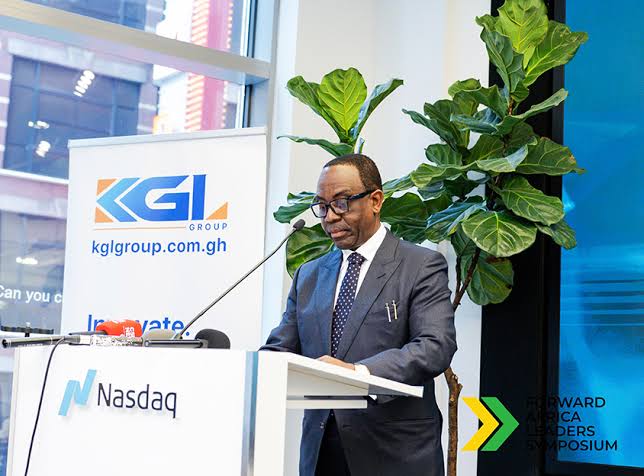
KGL Group Executive Chairman Alex Apau Dadey has called for stronger collaboration between government, the private sector and the media to create an environment that supports the growth of Ghanaian businesses into large, sustainable and globally competitive companies.
Mr. Dadey said Ghana must move beyond creating small and fragmented enterprises and deliberately develop pathways that allow small businesses to grow into medium-sized companies, large corporations and eventually African and global champions.
He made the call at the launch of the 30th Ghana Journalists Association (GJA) Media Awards, where KGL Group served as headline sponsor for the third consecutive year.
According to him, while small and medium-sized enterprises remain critical to employment, innovation and livelihoods, the country’s long-term economic transformation would require businesses capable of surviving their founders and succeeding across generations.
> “We must now become equally good at building large, well-governed, professionally managed and trans-generational Ghanaian businesses,” he said.
Mr. Dadey argued that the strength of an economy should not be measured only by the number of businesses created but also by the ability of those businesses to scale, create intellectual property, employ people, pay taxes and compete internationally.
He identified corporate governance, succession planning, competent and independent boards, professional management, patient capital and disciplined reinvestment as essential elements for building businesses that can endure beyond their founders.
Media urged to deepen economic reporting
The KGL Group chairman also called for a deeper relationship between Corporate Ghana and the media, stressing that such collaboration must not compromise journalistic independence.
He said journalists should continue to scrutinise businesses, investigate wrongdoing and question corporate power, but should also highlight legitimate Ghanaian enterprises that invest, innovate, create jobs, pay taxes and expand beyond Ghana.
“The media does not simply report an economy. The media helps shape the culture within which that economy develops,” he said.
Mr. Dadey urged journalists to contribute to a national conversation focused not only on who owns a company, but also on the value businesses create for Ghana.
He said questions about employment, local capacity development, tax contributions, innovation, international competitiveness and succession should increasingly form part of business reporting.
Call for evidence-based policymaking
Mr. Dadey further urged policymakers to make research and evidence the foundation of public policy.
He cautioned that policies introduced to address particular problems could sometimes create unintended consequences for businesses, investment and employment if they were not subjected to rigorous impact analysis.
“Good intentions are not enough. Policy must be supported by data. It must be informed by evidence,” he said.
He also called for broader consultation with businesses and other stakeholders before major policy and regulatory changes are implemented.
According to him, businesses can adapt to difficult policies, but uncertainty, inconsistent regulations and unpredictable policy environments can undermine long-term investment.
“Policy consistency, regulatory predictability and institutional stability are therefore not favours to Corporate Ghana. They are part of the infrastructure of economic development,” he said.
New compact needed
Mr. Dadey proposed what he described as a new compact involving government, Corporate Ghana and the media.
He said government must create an enabling environment, businesses must invest, innovate and strengthen their governance structures, while the media must continue to provide independent scrutiny and help the public understand enterprise, investment and economic transformation.
He also urged Ghanaian entrepreneurs to view their greatest legacy not merely as wealth accumulated, but as the institutions they leave behind for future generations.
“If every generation has to rebuild yesterday’s businesses from the ground up, nations cannot achieve industrial scale,” he said.
GJA Media Awards
Mr. Dadey congratulated GJA President Albert Kwabena Dwumfour, the association’s national executive, past executives and generations of Ghanaian journalists for sustaining the awards for three decades.
He urged journalists to pursue reporting that investigates ethically, interrogates policy, follows data and holds both government and businesses accountable.
At the same time, he encouraged the media to identify solutions, celebrate innovation and help Ghanaians envision the country’s economic potential.
He said the partnership between KGL Group and the GJA went beyond sponsorship and represented the company’s commitment to supporting journalism and national development.
Mr. Dadey expressed hope that by the time the GJA celebrates its 60th Media Awards, Ghana would have companies that have grown from small enterprises into African multinationals, survived their founders and expanded their operations and ownership across generations.
“Ghana’s next phase of development will require us to move from fragmentation to scale; from short-term thinking to generational thinking; from instinctive policymaking to evidence-based policymaking; and from simply creating businesses to deliberately building Ghanaian business champions,” he said.