

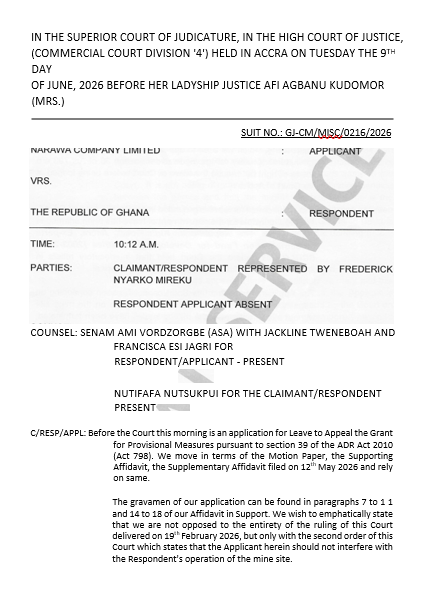
Narawa Company Limited has suffered a heavy legal setback after the High Court in Accra dismissed its application for leave to appeal against an earlier ruling on the protection of its mining operations pending arbitration.
The ruling leaves the substantive dispute over the termination of the company’s mining leases for the Arbitral Tribunal to determine, dealing a fresh blow to Narawa’s attempt to challenge the court’s earlier order.
The application by Narawa Company Limited for leave to appeal against an earlier ruling that restrained the state from interfering with the company’s operations at mining sites pending arbitration, was dismissed.
The Commercial Court Division of the High Court, presided over by Justice Afi Agbanu Kudomor, dismissed the application on the ground that the legality of the termination of Narawa’s mining leases is a matter reserved for determination by an Arbitral Tribunal.
In its ruling, the court held that the sole ground upon which Narawa sought to appeal concerned the legitimacy or otherwise of the termination of its mining leases, an issue already pending before the tribunal under the arbitration clauses in the mining agreements.
The court consequently ruled that it was the Arbitral Tribunal, and not another court, that had jurisdiction to determine the dispute over the termination of the leases.
“The Court is however not minded to grant the instant application,” Justice Kudomor stated in the ruling, adding that the earlier order was provisional and did not determine the merits of the dispute before the tribunal.
The application, filed on March 9, 2026, sought permission for Narawa to challenge the High Court’s February 19, 2026 order granting provisional measures under Section 39 of the Alternative Dispute Resolution Act, 2010 (Act 798).
Narawa had argued that it was challenging only the portion of the earlier ruling that prevented it from interfering with the company’s operations at the mine sites, insisting that the court should allow it to appeal that order.
The company maintained that the continued protection of its operations was unjustified because, according to its argument, the mining leases had been terminated. It further contended that the existing order preventing the state from transferring the mine sites to another entity was sufficient to preserve the status quo.
However, the Republic of Ghana opposed the application, arguing that an applicant seeking leave to appeal must demonstrate credible merit in the proposed appeal.
Counsel for the Republic submitted that the legality of the purported termination of the leases was the central issue in the pending arbitration and could not be determined by the High Court or the Court of Appeal outside the agreed arbitration process.
The state also argued that the February 19 order was a temporary protective measure intended to remain in force until the tribunal finally determined the dispute.
After considering the submissions of both parties and the accompanying affidavits, Justice Kudomor agreed that the proposed appeal centred on an issue within the jurisdiction of the Arbitral Tribunal.
The court emphasised that its earlier ruling had not determined the merits of the dispute over the termination of the mining leases.
Accordingly, the application for leave to appeal was dismissed, with the court making. No order as to costs.
The earlier order
The February 19, 2026 ruling had granted Narawa three provisional protections pending the final determination of the dispute by the Arbitral Tribunal.
These included an order restraining the state from forcefully removing or evicting the company from the mine sites covered by its mining leases, an order against harassment or interference with its operations, and a restriction on the state purporting to grant or transfer the sites to another person or entity.
The latest ruling does not finally determine whether the termination of Narawa’s mining leases was lawful. That substantive question remains for the Arbitral Tribunal to resolve.