

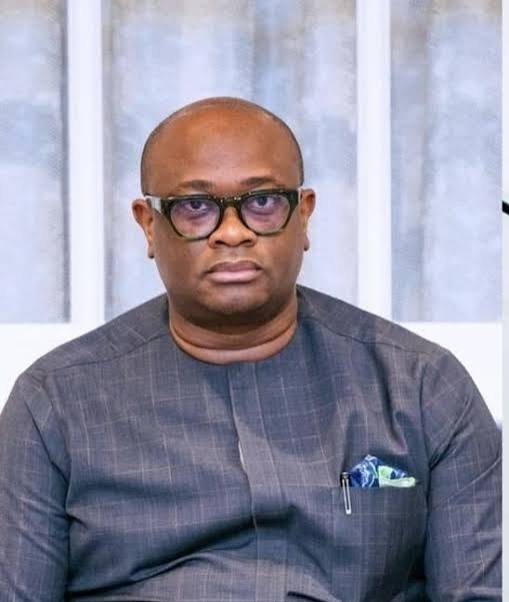
Story By: Nii Okpoti Odamtten / Muhammad Faisal Mustapha…
In the quiet, highly controlled corridors of executive power where decisions are refined, priorities aligned, and the machinery of governance set into motion impact is rarely measured by visibility. It is measured by precision, coordination, and the ability to turn policy into action. At the heart of this operational nexus stands Hon. Stanislav Xoese Dogbe, a figure increasingly recognized as one of the key architects behind the day to day efficiency of Ghana’s Presidency.
As Deputy Chief of Staff in charge of Operations, Hon. Dogbe occupies what insiders often describe as the “engine room” of government a space where ideas are transformed into executable programmes and where national priorities are translated into measurable outcomes.
Hon. Dogbe’s journey to the Presidency is both unconventional and instructive. Before entering the sphere of high level governance, he distinguished himself in Ghana’s competitive media landscape, notably as a producer of the widely respected Super Morning Show on Joy FM.
There, he honed a rare skill: the ability to shape national discourse while navigating the complexities of public opinion.
“The newsroom teaches you urgency, accuracy, and accountability,” a close associate reflects.
“In governance, those same principles become even more critical because decisions affect millions.”
This grounding in media and communication would later become one of Hon. Dogbe’s most valuable assets, enabling him to bridge the often delicate gap between policy formulation and public understanding.
Hon. Dogbe’s ascent within the political orbit of President John Dramani Mahama was shaped by years of consistency, discretion, and strategic insight.
Serving in various communications and advisory roles, he developed a reputation for managing complex political environments with calm precision coordinating stakeholders, aligning institutional priorities, and ensuring clarity in government messaging.
“Effective governance is not only about making decisions,” Hon. Dogbe is quoted as saying.
“It is about ensuring those decisions are understood, implemented, and felt by the people.”
Today, in his role at the Presidency, Hon. Dogbe’s responsibilities extend far beyond coordination. He operates at the intersection of strategy and execution overseeing government functions, facilitating inter agency collaboration, and supporting major national interventions.
From high level administrative planning to initiatives such as flood mitigation efforts in Accra, his office plays a pivotal role in ensuring that government responses are not only timely but effective.
“At the Presidency, execution is everything. Strategy without delivery is merely intention.”
Colleagues describe him as methodical, forward thinking, and deeply committed to results traits that have become essential in an era where governance is increasingly judged by outcomes rather than promises.
Beyond the formal structures of office, Hon. Dogbe’s story reflects a broader narrative about leadership in modern governance: the fusion of communication, strategy, and service.
His ability to understand how narratives shape public trust and how execution sustains it positions him uniquely within Ghana’s administrative framework.
“Public service demands more than visibility it demands responsibility, discipline, and consistency.”
In a rapidly evolving political landscape marked by heightened public expectations and complex national challenges, Hon. Dogbe remains a relatively understated yet influential presence.
Observers note that his strength lies not in public spectacle, but in his capacity to ensure that the wheels of government turn smoothly behind the scenes.
As Ghana continues to navigate economic pressures, urban challenges, and institutional reforms, figures like Hong. Stanislav Xoese Dogbe represent the operational backbone of governance professionals whose work, though often unseen, is indispensable.
“The true test of leadership,” a senior government official notes,
“is not how loudly it speaks, but how effectively it delivers.”
With governance increasingly defined by efficiency, coordination, and measurable impact, Hon. Dogbe’s role is likely to grow even more significant in shaping how policy translates into progress.
In the engine room of the Presidency where pressure is constant and expectations are high his blend of media intelligence, strategic foresight, and administrative discipline continues to power the system forward.