

By: Muhammed Faisel Mustapha / Felix Ernest Odamtten
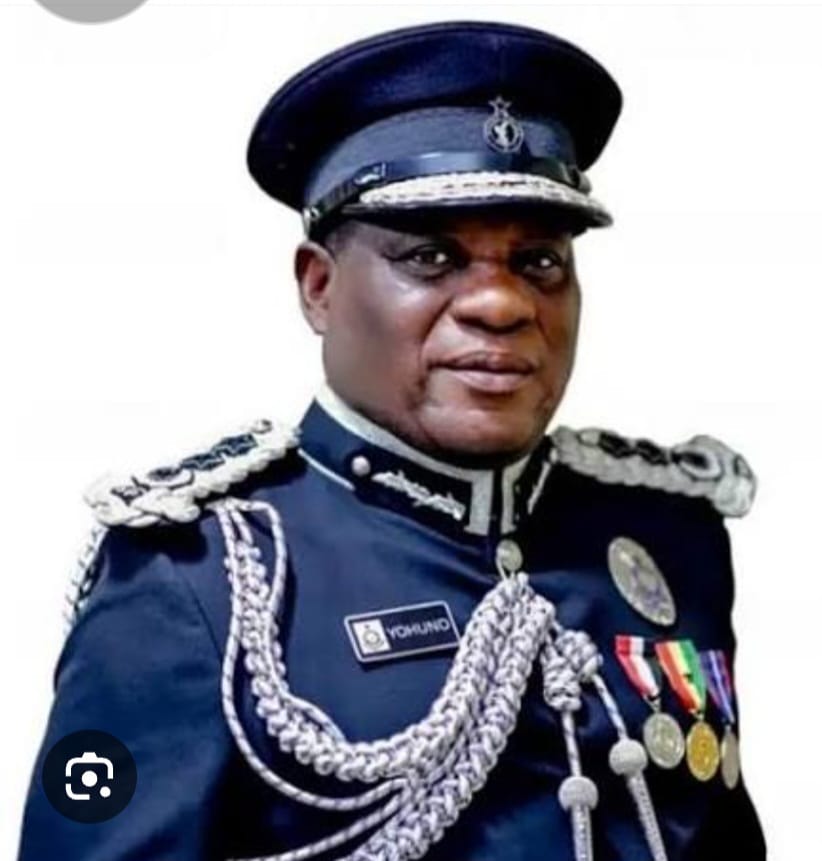
For nearly four decades, Christian Tetteh Yohuno has worn the uniform of the Ghana Police Service, building a career across operational command, administration, intelligence and crime prevention. His rise to the highest professional office in the Service has been shaped by field experience and senior command responsibilities rather than rank alone.
Today, as Inspector-General of Police, Yohuno is leading Ghana’s Police Service at a time when the nature of criminal threats is becoming increasingly complex. His professional record has placed particular emphasis on intelligence led policing the use of information, analysis and targeted operations to prevent crime before it develops into tragedy.
For many of his supporters, that record makes his emergence as IGP particularly significant. They regard him as a timely and experienced police leader whose career has prepared him for the demands of protecting a country where organised crime, illegal firearms and violent robbery remain serious security concerns.
President John Dramani Mahama appointed Yohuno as Inspector-General of Police on March 13, 2025. He was subsequently sworn into office on March 14, 2025, becoming the 31st IGP of the Ghana Police Service and the 25th Ghanaian to occupy the position since independence, according to the Ghana Police Service.
His journey began decades earlier, following his entry into the Ghana Police Service after police training at Winneba in the 1980s. From the lower ranks, he steadily progressed through increasingly demanding assignments, gaining exposure to the operational realities of policing and the administrative responsibilities of senior command.
Among the positions associated with his career were Regional Finance Officer, Divisional Commander, Accra Central Divisional Commander and Accra Regional Operations Commander. His service in Accra placed him in some of Ghana’s busiest and most challenging policing environments.
Between November 2007 and May 2009, he served as Accra Central Divisional Commander while also performing duties as Accra Regional Operations Commander. He subsequently became Deputy Accra Regional Commander and later served as Accra Regional Commander from 2013 to December 2015.
In 2015, Yohuno became Director-General of the Motor Traffic and Transport Department. He was subsequently promoted to Commissioner of Police and served in other senior Director-General positions, including Special Duties and Administration, broadening his experience beyond frontline policing.
But the most distinctive chapter of his career was his association with police intelligence. He became the first Director-General of the Police Intelligence Directorate, helping establish an institutional framework in which intelligence gathering, analysis, criminal profiling and operational deployment could work together.
The philosophy behind intelligence led policing is straightforward but powerful: the Police Service should not always wait for criminals to strike before responding. Ghana’s Police Service itself defines the Police Intelligence Directorate’s responsibilities to include gathering intelligence, tracking and predicting crime, profiling persons of interest, cultivating credible informants and passing processed information to commanders for appropriate action.
“The strongest police victory may be the crime that never happens.”
That philosophy is particularly relevant to violent crime. A robbery prevented, a criminal network disrupted or a weapon intercepted before it reaches its intended destination may never become a headline, yet each represents a potential life saved and a family spared the consequences of violence.
Yohuno’s operational career was forged during periods when armed robbery and violent crime posed significant challenges, particularly in Greater Accra. His command appointments required rapid decision making, intelligence gathering, coordination of officers and the ability to respond to threats under considerable pressure.
His contribution to policing was recognised in 2011 when he received the Grand Medal for meritorious service. The recognition formed part of a career in which operational policing and intelligence increasingly became intertwined.
His work has also been associated with efforts to identify organised robbery groups, carjacking networks and other criminal operations. Cases involving suspected vehicle theft networks and major criminal investigations contributed to the development of his reputation as a police officer who placed considerable emphasis on intelligence before deployment.
His intelligence responsibilities also intersected with investigations into major criminal incidents, including the attack on the Kwabenya Police Station and the murder of a Lebanese national in Tema. Such cases illustrate the importance of connecting intelligence, investigation and operational policing rather than treating them as isolated functions.
One initiative attributed to his intelligence led approach was an Informant Reward System, intended to encourage members of the public to provide useful information to investigators. The underlying principle was that effective policing cannot depend exclusively on uniformed officers being present at every location.
The principle remains relevant: police officers cannot be everywhere, but credible information can move quickly across communities. When properly assessed and lawfully acted upon, such information can give security agencies an opportunity to intervene before a criminal plan becomes an attack.
Yohuno’s professional experience has also extended beyond Ghana. His career included United Nations peacekeeping assignments in Bosnia and Herzegovina and East Timor, exposing him to international policing environments and security challenges that required coordination, intelligence gathering and conflict sensitive operations.
Those experiences added an international dimension to a career that had already encompassed divisional command, regional leadership, intelligence, administration and special operations. In July 2024, he was appointed Deputy Inspector-General of Police in charge of Operations before assuming the office of IGP in March 2025.
His appointment therefore represented more than the promotion of a senior police officer. It placed at the head of Ghana’s Police Service a professional whose career had moved repeatedly between intelligence, operations and command—a combination that is increasingly important in modern policing.
“INTELLIGENCE. OPERATIONS. PREVENTION.”
The practical sequence is clear: gather information, assess the threat, identify suspects or criminal networks, deploy strategically and act within the law. When that chain works effectively, the objective is not simply to arrest offenders after a crime but to disrupt the criminal plan before innocent people become victims.
The importance of that approach was highlighted in January 2026 when 30 police officers were promoted for their roles in two major operations in the Ashanti Region. One operation resulted in the recovery of 2,600 rounds of AK-47 ammunition at the Kantanso-Asankare Police Barrier, while another intelligence led operation disrupted a suspected robbery syndicate along the Antoakrom-Manso Nkwanta stretch.
In the Antoakrom-Manso Nkwanta operation, police said intelligence led a rapid response team to a location where four armed suspects had gathered allegedly to attack commuters. Two suspects were fatally wounded after police said the group opened fire, while two others escaped; firearms, ammunition and a vehicle believed to have been used in criminal operations were subsequently recovered.
The recovery of 2,600 rounds of ammunition demonstrated the potentially grave consequences of successful intelligence-led interception. Ammunition of that quantity in criminal hands could have facilitated serious violence, although the full circumstances surrounding the consignment remained subject to investigation. The broader lesson is that effective policing often operates in the space between intelligence received and tragedy prevented.
Ghana needs a Police Service capable of anticipating threats as well as responding to them. It needs commanders who understand communities, criminal networks, intelligence systems and operational realities, while maintaining professionalism, accountability and respect for due process. Yohuno’s nearly four decades of experience provide a substantial foundation for that responsibility.
From a young recruit to Accra Central Divisional Commander; from regional command to senior Director-General positions; from intelligence leadership to Deputy IGP in charge of Operations; and ultimately to Inspector-General of Police, Yohuno’s career represents a long progression through the institutional architecture of Ghanaian policing. His supporters may describe his rise as providential, but the measurable test of his leadership will remain public safety, professional policing, crime prevention and public confidence.
His greatest victories may never become headlines. They may be robberies that never occur, weapons intercepted before they are used, criminal networks disrupted before they strike and families who never discover how close danger once came to their doorsteps. That is the compelling case for intelligence led policing and it is why Christian Tetteh Yohuno’s leadership has become an important chapter in Ghana’s continuing effort to stay ahead of violent crime.