

…As It Recruits Land Guards With Koforidua Reg. Police Backup
Serious concerns have emerged over allegations that individuals linked to the Ghana Police Service, alongside armed land guards, were involved in disrupting the operations of a Ghanaian-owned investment at a quarry site in Akosombo, raising questions about the conduct of the security personnel and the protection of legitimate business interests.
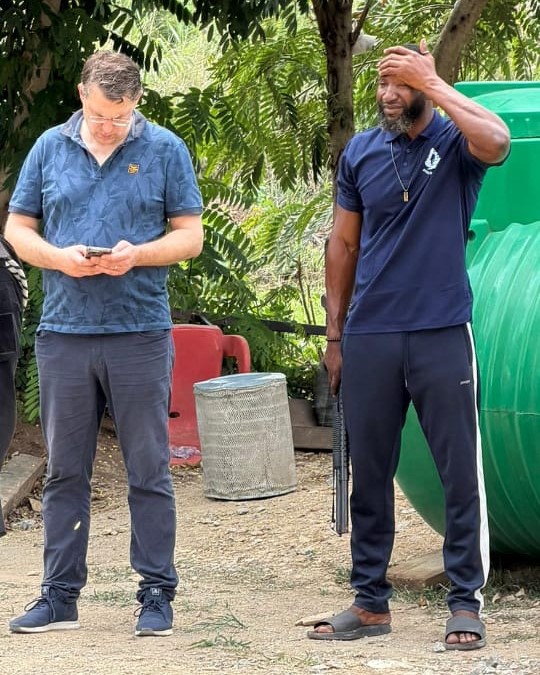
According to reliable information gathered from the affected business interests, armed men reportedly stormed the legally operating quarry belonging to Klos & Hauls Limited (KHL), at about 8:30 p.m. on December 12, 2025, and allegedly ordered workers off the site.
The incident has triggered concerns about the use of force in commercial and mining-related disputes, with calls for the matter to be subjected to proper legal and regulatory scrutiny.
The affected investors contend that instead of resolving the underlying dispute through the courts or relevant state institutions, individuals described as land guards were allegedly deployed to take control of the site.
Information is that up until 2026, Ghacem never secured a mining permit on any part of the concession, and had never engaged the landowners, neither did they ever pay any surface rights compensation.
The information further indicate that Ghacem never engaged the traditional authority, and therefore, there has never been any evidence of Ghacem ownership until August, 2026, when they filed a document of lease dated March 2014.
The concession acquired by Klos & Hauls Limited (KHL) in 2022 and duly gazette on December 20, 2022.
The company has since been working on the concession, making huge investments without any hindrance until recently, GHACEM launched its attacks.
Information gathered is that GHACEM had allegedly maneuvered with the support of some people placed at the EPA and Minerals Commission, to pay its 11 years outstanding arrears to the Minerals Commission.
This incident also raised questions about the conduct of individuals said to be connected to the police, particularly where their presence or actions could have contributed to the removal of workers from a private commercial operation.
Corporate accountability questions
The dispute has also drawn attention to GHACEM, one of Ghana’s largest cement manufacturers, and its corporate ownership structure.
GHACEM is majority-owned by Heidelberg Materials, formerly HeidelbergCement, which holds approximately 93.1 per cent of the company. The Government of Ghana holds a minority stake of about five per cent.
The ownership structure has prompted calls for greater public scrutiny of the circumstances surrounding the alleged incident, particularly regarding corporate governance, responsible business conduct and respect for the rule of law.
Critics argue that companies operating in Ghana, particularly those with significant international ownership, have a responsibility to ensure that commercial disagreements are handled through lawful and transparent processes rather than through intimidation or the use of force.
Information however is that, one Joseph Red Tekper was on tape confessing at the Akosombo Police Station that he was asked by the GHACEM Trio (Twum, Amanor and Addison) to mobilize land guards to the site at Sedom.
Nana Duah Twum Barimah, Eric Amanor and Justice Addison are the trio from Ghacem who are on the grounds doing the ‘dirty jobs’ for the MD.
Information gathered is that GHACEM MD, who is bent on ensuring that he takes over the concession for the Ghanaian businessman claims to have the backing by some people strategically positioned in public offices, the EPA and Minerals Commission.
Dispute belongs in court, not on the field
At the centre of the controversy is a broader question: Can a commercial or mining dispute justify the deployment of armed men to a business premises to remove workers?
The affected investors insist that disputes over land, quarrying rights or mining operations should be determined by the courts and competent regulatory agencies.
They therefore want the circumstances surrounding the December 12 incident thoroughly investigated, including the identities and authority of the armed men who allegedly entered the quarry, the role of any police personnel present, and whether proper legal procedures were followed.
The case also raises questions about the protection of Ghanaian businesses and investors whose operations may become embroiled in land or commercial disputes.
Calls for independent investigation
Stakeholders are calling for an impartial investigation to establish what happened on the night of December 12, 2025, and whether any police officers or other state actors participated in or facilitated the alleged action.
The investigation, they say, should determine whether the men had lawful authority to enter the quarry, remove workers or interfere with the company’s operations.
It should also establish whether any court order, police directive or regulatory decision existed authorising the action.
For the affected investors, the incident goes beyond a private commercial dispute and touches on Ghana’s investment climate, the protection of private property and confidence in the rule of law.
The central question now is whether commercial disagreements in Ghana are to be resolved through the courts and lawful regulatory processes—or through the use of armed groups and alleged police influence.
The twenty Share-holder families of the said concession are urging President Mahama to reset this as well as according to them, for seven decades, Ghana has enjoyed independence, yet much of its economy remains in foreign hands. In the name of Foreign Direct Investment (FDI), we have allowed foreign investors to dominate opportunities that should also benefit Ghanaians.
They make references to South Africa, Rwanda and Tanzania, where laws and policies protect local participation in business and land ownership.
“Ghana must also recognise that a country that does not own its economy risks becoming dependent on others. We welcome foreign investors while local entrepreneurs struggle to access contracts, land and mineral concessions because they are considered to lack capacity or funds. Instead of building Ghanaian businesses, our policies often favour foreign dominance,” they said.
“If we don’t own the economy that feeds us, our independence is incomplete. The time has come for Ghana’s wealth to work for Ghanaians, President Mahama must reset economy to put Ghanaians first.”
They averred that the time has come for Ghana’s wealth to finally work for Ghanaians and that 69 years on, Ghanaians still spectators in their own economy.
The tragedy goes beyond ownership. Profits leave the country, while mining and quarrying communities are left with polluted rivers, damaged land and limited benefits.
They commend former President Nana Addo Dankwa Akufo-Addo for his role in enabling Ghanaian businessman Ibrahim Mahama to acquire Damang Mines.
According to the families, this should become a precedent, not an isolated case.
“President John Dramani Mahama must now reset this narrative. The looming Ghacem involvement in limestone concessions in the Eastern Region presents an important test of Ghana’s commitment to local ownership. Capacity can be built; it should not be used as an excuse to exclude Ghanaians. The government must prioritise citizens in the allocation of land and concessions and require foreign companies in strategic sectors to partner with local investors. If Ghanaians do not own the means of their economic survival, their independence remains incomplete. Ghana’s resources and opportunities must benefit Ghanaians first.”