

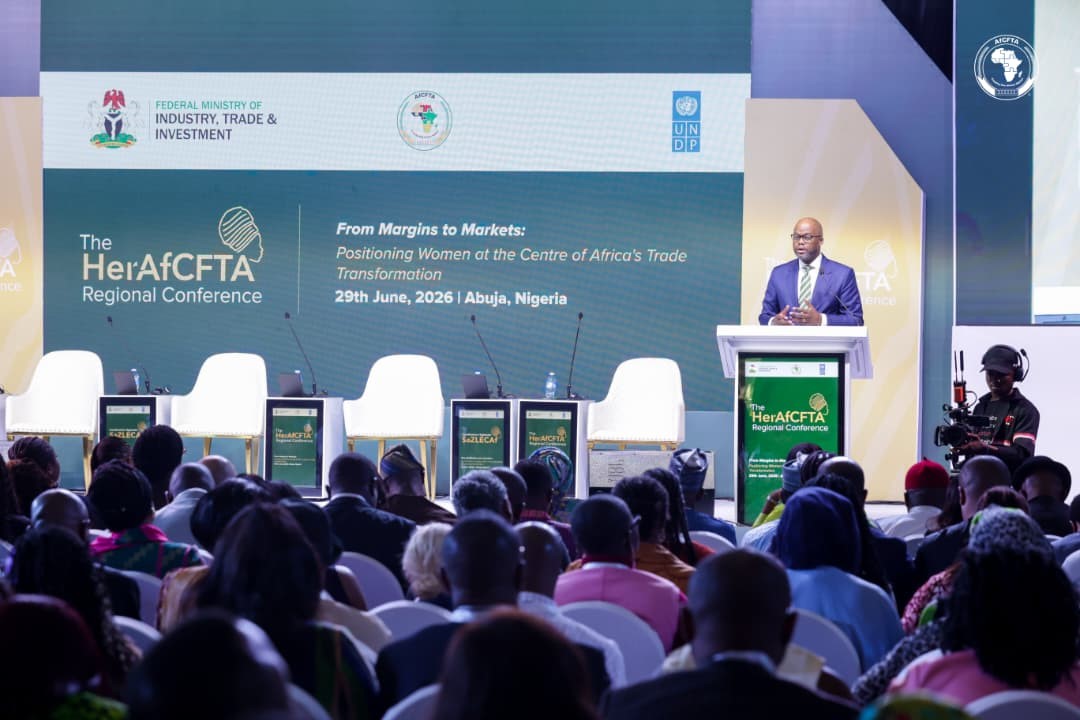
The Secretary-General of the African Continental Free Trade Area Secretariat, H.E. Wamkele Mene, has asserted that Africa’s economic transformation will depend significantly on the ability of women entrepreneurs to participate fully in continental trade,
Speaking at the HerAfCFTA Regional Conference 2026 in Abuja, Nigeria, H.E. Mene emphasized that women are already among the most active drivers of trade across Africa and must therefore be placed at the centre of the continent’s economic integration agenda.
He noted that unlocking the full potential of women-owned and women-led enterprises is not only a matter of inclusion, but also a strategic requirement for Africa’s long-term growth, industrialization and prosperity.
According to the Secretary-General, the AfCFTA provides a historic opportunity to address the long-standing barriers that have prevented many women from expanding their businesses beyond national borders. These barriers include limited access to finance, inadequate trade information, high transportation and logistics costs, complex customs procedures, weak business networks and restricted access to formal markets.
H.E. Mene described the AfCFTA Protocol on Women and Youth in Trade as the first legally binding instrument of its kind in the world which is a major instrument designed to respond to women and youth-led businesses.
The Protocol is intended to create a more inclusive continental trading system by removing obstacles that disproportionately affect women and young entrepreneurs. It also seeks to expand access to finance, improve market opportunities and strengthen the participation of women in higher-value sectors of the African economy.
These sectors include manufacturing, logistics, digital technology, mining, agriculture, professional services and regional value chains. Increased participation in such sectors would enable women to move beyond small-scale and informal trade into more productive, competitive and export-oriented businesses.
H.E. Mene stressed, however, that the adoption of the Protocol alone would not be sufficient. Its impact will ultimately depend on how effectively governments and other stakeholders translate its provisions into practical support for women entrepreneurs.
This will require coordinated action by African governments, the private sector, development partners, banks and other financial institutions. National institutions will also need to align their trade, industrial, financial and entrepreneurship policies with the objectives of the Protocol.
Priority interventions should include affordable financing, targeted training, improved digital and physical infrastructure, simplified trade procedures and stronger cross-border business networks. Women entrepreneurs must also be provided with timely information on market opportunities, rules of origin, customs requirements and available trade-support services.
Financial institutions have an especially important role to play by designing products that reflect the realities of women-owned businesses, many of which struggle to meet conventional collateral requirements despite operating viable enterprises.
The private sector can also support implementation through supplier development programmes, mentorship, technology transfer and the inclusion of women-owned enterprises in regional supply and value chains.
The Secretary-General’s remarks reinforced the broader vision of the AfCFTA as an instrument for inclusive economic transformation. As implementation gathers momentum across the continent, the Agreement is expected to create new opportunities for enterprises to access larger markets, attract investment and expand production.
For these benefits to be widely shared, however, women must not remain on the margins of Africa’s trading system. They must be supported as producers, manufacturers, exporters, service providers and investors.
The HerAfCFTA Regional Conference therefore served as an important platform for strengthening collaboration and renewing commitment to turning the Protocol on Women and Youth in Trade into tangible opportunities.
Africa’s economic future, H.E. Mene concluded, will be stronger when women are equipped with the finance, skills, infrastructure and networks required to grow their businesses and trade confidently across the continent.