

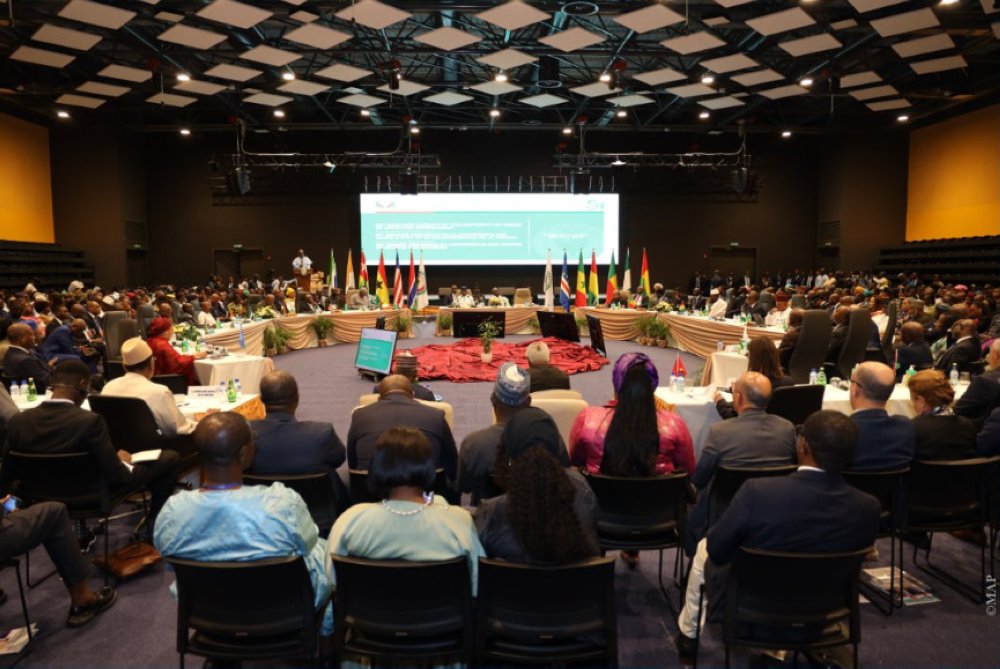
The signing in Freetown of an intergovernmental agreement governing the Nigeria–Morocco African Atlantic Gas Pipeline marks a significant step towards the development of one of Africa’s most ambitious energy infrastructure projects.
Initiated by Morocco’s King Mohammed VI and former Nigerian President Muhammadu Buhari, the pipeline is increasingly emerging as a West African integration project rather than a solely bilateral undertaking.
West African leaders have formally endorsed the legal and institutional framework governing the Nigeria–Morocco African Atlantic Gas Pipeline, a proposed 6,800-kilometre energy corridor intended to transport Nigerian natural gas across the Atlantic coast of Africa to Morocco, with the possibility of eventually supplying European markets.
The intergovernmental agreement was signed on Sunday in Freetown during a summit of heads of state and government of the Economic Community of West African States, or ECOWAS.
The agreement formalises the collective participation of ECOWAS member states in the pipeline’s legal and institutional framework, giving the project broader regional political backing and moving it closer to its operational phase.
Originally conceived as a joint initiative between Morocco and Nigeria, the project was launched following King Mohammed VI’s visit to Nigeria in 2016 and his discussions with the country’s then-president, the late Muhammadu Buhari.
The initiative has since received the renewed backing of Nigerian President Bola Ahmed Tinubu. It is being jointly developed by Morocco’s National Office of Hydrocarbons and Mines (ONHYM), and the Nigerian National Petroleum Company Limited (NNPC).
Moroccan officials describe the pipeline as a central component of King Mohammed VI’s vision for an economically integrated, prosperous and energy-secure Africa. The project also reflects Rabat’s broader approach to South-South cooperation, based on regional connectivity, shared infrastructure and the development of African resources for the benefit of African economies.
The Freetown agreement represents an important institutional milestone by incorporating ECOWAS countries into a common legal framework for the pipeline’s development and governance.
Morocco is not an ECOWAS member but was associated with the ceremony as one of the project’s two founding partners.
The Freetown signing does not, however, represent the final stage of the institutional process. A separate ceremony is expected to be held in Morocco involving Morocco, Nigeria and Mauritania.
Mauritania, like Morocco, is not a member of ECOWAS but is a key country along the proposed pipeline route.
The forthcoming ceremony is expected to focus on arrangements for the establishment of the project’s management and operating structures, marking the transition from regional political endorsement to technical, financial and operational implementation.
The next phase of the project will include the creation of a dedicated project company, which is expected to be based in Casablanca.
A separate pipeline governance body, referred to as the Pipeline Higher Authority, is expected to have its headquarters in Abuja.
Together, the two institutions would oversee the project’s operational, regulatory and financial dimensions, while coordinating relations between participating governments, national energy companies, investors and international financial institutions.
Once these governance structures are established, the project partners are expected to intensify efforts to mobilise investors and financing ahead of a final investment decision.
ONHYM and NNPC Ltd. have said that the main technical, environmental and engineering studies have been completed, allowing the pipeline to move progressively towards its development phase.
The planned ceremony in Morocco is therefore expected to represent a decisive shift from institutional preparation to implementation.
Once completed, the African Atlantic Gas Pipeline would cross 13 countries along Africa’s Atlantic coastline before reaching Morocco, where it would connect to the existing Maghreb–Europe Gas Pipeline network.
The pipeline is expected to have an annual transportation capacity of approximately 30 billion cubic metres of natural gas.
Up to 15 billion cubic metres could eventually be supplied to Morocco and European markets, while the remaining volumes would be used to meet demand in participating West African countries.
The project is estimated to cost approximately $25 billion. The first sections could enter service during the early years of the next decade, although the overall construction timetable will depend on financing, regulatory coordination and the completion of technical preparations.
Given its scale, the pipeline would rank among the largest infrastructure projects undertaken on the African continent.
Its implementation will require sustained coordination between the countries along the route, regional organisations, energy operators, development institutions and private investors.
Morocco–Nigeria partnership at the project’s core
The strategic partnership between Morocco and Nigeria remains the foundation of the project.
Developed over the past decade, the partnership is based on sustained political dialogue and a shared commitment to strengthening African economic integration.
Rabat and Abuja have jointly promoted the project since its inception, while cooperation between ONHYM and NNPC Ltd. has provided its principal technical and institutional framework.
The partnership combines Nigeria’s position as one of Africa’s leading natural gas producers with Morocco’s infrastructure experience and strategic geographical position between sub-Saharan Africa, Europe and the wider Atlantic region.
The cooperation also extends beyond the gas sector, covering broader economic, diplomatic, industrial and security interests.
The project’s gradual progress reflects the two countries’ decision to pursue a phased approach, beginning with political consultation and feasibility studies before moving towards institutional, financial and operational arrangements.
The African Atlantic Gas Pipeline is intended to serve not only as a gas transportation system but also as a regional development corridor.
Several countries along the proposed route continue to face energy shortages, limited electricity generation and high production costs. Access to natural gas could support more reliable power generation and strengthen the competitiveness of local industries.
The pipeline could also provide participating countries with an opportunity to connect their own gas reserves to a regional transmission network, encouraging domestic resource development and investment.
Supporters of the project argue that it could stimulate industrialisation, facilitate local processing of raw materials and generate employment across the region.
By helping to create an integrated West African gas market, the pipeline could also strengthen economic interdependence and reduce reliance on more expensive or environmentally damaging fuels.
For European countries seeking to diversify their energy supplies amid geopolitical uncertainty, the project could eventually provide an additional source of natural gas.
However, its primary strategic objective remains the development of African energy markets and the improvement of energy access in the countries along its route.
The pipeline forms part of King Mohammed VI’s wider Atlantic vision, which seeks to transform Africa’s Atlantic coastline into an interconnected area of economic cooperation and shared development.
The strategy aims to strengthen transport, trade and energy links between African countries while expanding the continent’s connections with Europe and the Americas.
It also complements Moroccan initiatives intended to improve the access of landlocked African countries to Atlantic ports and international markets.
In this context, the pipeline is presented as an “energy highway” and a “development highway”, connecting territories, economies and populations through shared infrastructure.
The endorsement of the intergovernmental agreement in Freetown confirms that the project has moved beyond its original bilateral framework.
What began as a strategic initiative between Morocco and Nigeria is now increasingly being embraced as a regional West African undertaking, with potential implications for energy security, industrial development and economic integration across the continent.
The Freetown signing is therefore an important milestone, but not the final one. The project’s next major test will be the establishment of effective governance and financing structures capable of translating political support into construction and long-term operation.