

By Yvette Ahenkorah
Climate change is not merely an environmental concern reserved for policy rooms, international conferences, or scientific reports. It is an everyday reality. It is slowly, and often quietly, becoming part of the lived experience of our communities, cities, households, and livelihoods. Many of the climate realities we face do not always appear in dramatic ways. Sometimes, they show up as flash floods in communities such as Dansoman, Weija, Taifa, and parts of the Odaw Basin after only a few hours of heavy rainfall. At other times, they appear as prolonged droughts and growing food insecurity in farming communities across northern Ghana, where erratic rainfall continues to threaten harvests, incomes, and household survival.
Across the continent, communities in the Horn of Africa have endured recurring droughts that have left millions struggling to access food and water. In rapidly growing cities such as Accra, Lagos, and Nairobi, climate change is also reflected in worsening air quality, driven by emissions, dust, poor waste management, and open burning. And then there is the heat; the kind that many residents of Accra, Kumasi, Takoradi, and Somanya know too well, where rising temperatures and prolonged heat waves are making daily life, work, and even sleep more difficult than before.

Climate Change Is Already Here
These are not distant projections of what may happen in the future. They are realities that many people across Africa are already living through today. The truth is that climate change rarely announces itself loudly. It settles into the ordinary rhythms of life, gradually disrupting systems we once assumed were stable. It affects how we move through our cities, the food available on our tables, the quality of the air we breathe, the safety of our homes, and the dignity of our livelihoods.
Yet, despite the scale of the challenge, climate action is not beyond us. Real transformation begins with the recognition that the climate crisis is not only about the environment. It is also about people, justice, health, livelihoods, infrastructure, and the future of our communities. Climate action requires bold policy decisions and systemic reforms, but it also requires individual and collective responsibility.

Community Action and Climate Resilience
This is a reality we continue to witness through our work at Alliance for Empowering Rural Communities. Working alongside communities has shown us that resilience is not built only through large-scale projects or ambitious national commitments. It is also built through local action, community ownership, and a shared understanding of the challenges people face every day. Whether through engaging residents on sustainable waste management practices, supporting environmental awareness initiatives, advocating for more resilient communities, or creating platforms for dialogue on climate and urban development, we have seen how communities become powerful agents of change when they are equipped with knowledge, resources, and opportunities to act.
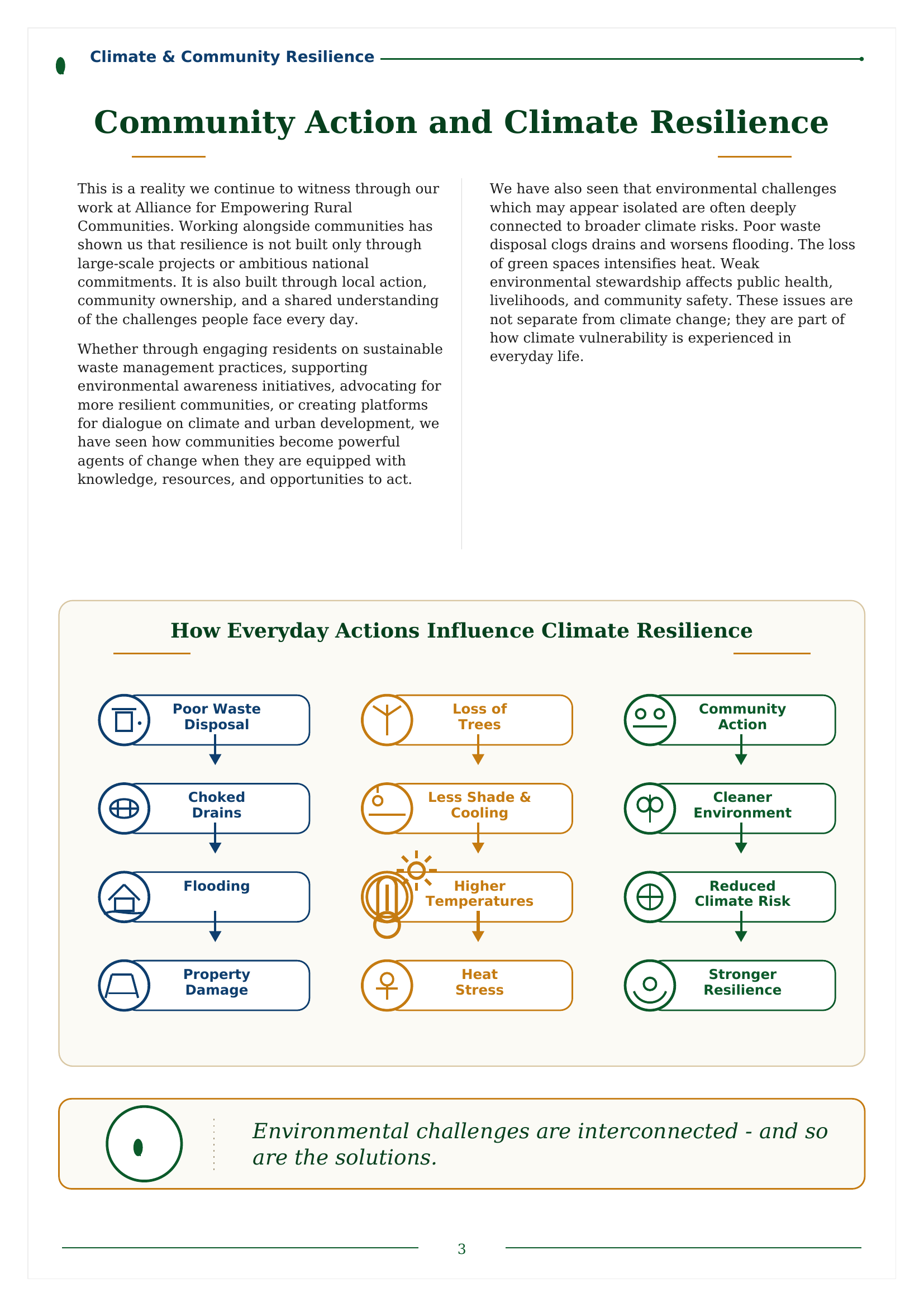
We have also seen that environmental challenges which may appear isolated are often deeply connected to broader climate risks. Poor waste disposal clogs drains and worsens flooding. The loss of green spaces intensifies heat. Weak environmental stewardship affects public health, livelihoods, and community safety. These issues are not separate from climate change; they are part of how climate vulnerability is experienced in everyday life.

Building Resilience Together
In many communities, climate action begins with practical steps that may seem small but carry significant impact. It begins with protecting and restoring green spaces, reducing waste, embracing sustainable farming practices, safeguarding natural waterways, and promoting responsible environmental stewardship. It begins with recognising that resilience is not something imposed from outside, but something cultivated from within communities themselves. Perhaps one of the most important lessons climate change teaches us is that our relationship with the environment matters. It matters how we consume, how we travel, how we manage waste, how we build, and how we care for the spaces around us. Every action contributes either to the problem or to the solution. Ultimately, climate action must be a collective effort. Governments must strengthen policy and invest in resilient infrastructure. Institutions must support communities with resources and technical capacity. Civil society must continue to mobilise, educate, and hold systems accountable. Communities and individuals must also recognise their power to act before disasters occur. Working with communities has reinforced a simple but powerful truth: people care about the future when they can see how it connects to their present. Climate action becomes meaningful when it speaks to the flooded street after a storm, the farmer worried about the next planting season, the family struggling through extreme heat, or the community seeking cleaner and healthier surroundings.

“Community Resilience Wheel Climate Awareness Community Stewardship Resilient Communities Sustainable Agriculture Environmental Education Flood Prevention Sustainable Waste Management Tree Planting & Green Spaces Climate resilience is not something we wait for. It is something we build together, through the choices we make, the systems we change, and the actions we take every single day”
Quietly, everything is changing. The question is whether we will change with it, deliberately, urgently, and together.
The author, Yvette Ahenkorah, is a climate advocate and civil society professional with interests in sustainability, resilience, and urban development. She is passionate about helping people better understand how climate change shapes everyday life and the systems around us.