

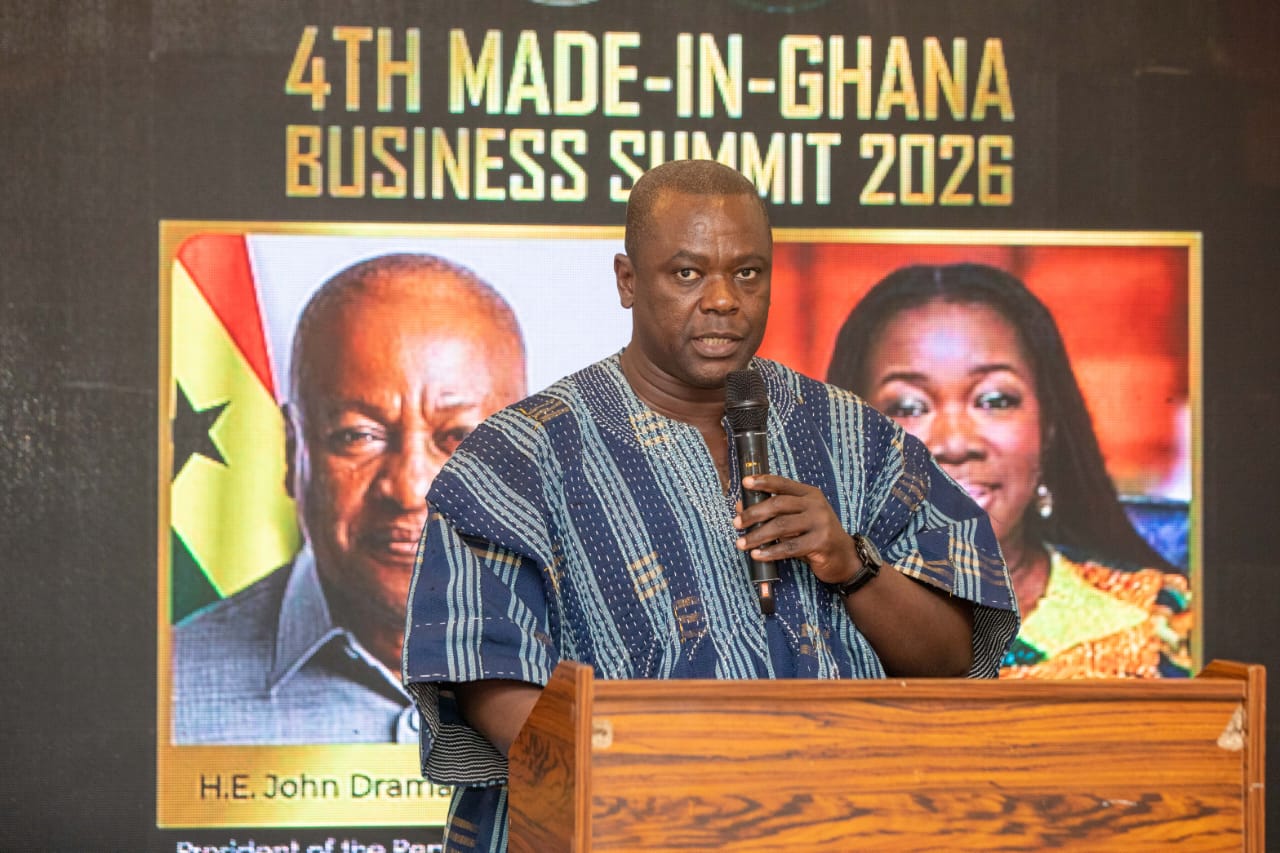
Mining industry expert Dr. Atoapem Frimpong Barimah has called for a major shift in Ghana’s local content strategy, urging the country to move beyond importing and reselling mining products to establishing local manufacturing industries that create jobs, transfer technology and drive industrial growth.
Delivering a speech at the 4th Made-in-Ghana Business Summit 2026 at the Labadi Beach Hotel in Accra, Dr. Barimah said Ghana’s mining sector should focus not only on the volume of minerals extracted but also on the value retained within the country.
Speaking on the theme, “Local Content in the Mining Value Chain in Ghana: A Lever for Sustainable Value Creation,” he stressed that local content should go beyond regulatory compliance to ensure the meaningful participation of Ghanaian businesses, institutions and citizens across the entire mining value chain.
According to him, although Ghana has made progress in increasing the participation of local companies in providing logistics, engineering, security, catering and environmental services to mining firms, much of the country’s mining consumables, equipment, chemicals and spare parts are still imported.
He argued that the continued importation of mining inputs exports employment opportunities to other countries while limiting technology transfer, industrial development and research in Ghana.
Dr. Barimah proposed a new approach that promotes joint ventures between international manufacturers and capable Ghanaian companies to establish factories in the country for the production of mining inputs.
He further recommended that mining companies support such investments through long-term Forward Purchasing Agreements to guarantee demand and encourage investors to establish manufacturing facilities in Ghana.
He said local manufacturing would create jobs, strengthen local supply chains, support the growth of small and medium-sized enterprises, increase government tax revenue and reduce the country’s dependence on imports.
Dr. Barimah also called for stronger collaboration among government, mining companies, financial institutions and academic institutions to create an enabling environment for industrialisation. He urged government to provide favourable policies and investment incentives, while financial institutions make affordable capital available to local manufacturers.
He added that universities and technical institutions must equip Ghanaians with the skills required for advanced manufacturing to support the country’s industrial transformation.
“Ghana possesses not only mineral resources but also the human potential to build a globally competitive mining industry,” he said.
He concluded by stating that the success of Ghana’s local content policy should be measured not by the number of local distributors but by the number of products designed, manufactured and exported from Ghana.
“If we successfully combine Joint Ventures, local manufacturing and Forward Purchasing Agreements, mining will become more than an extractive industry. It will become the foundation of Ghana’s industrial transformation,” he said, urging stakeholders to “move from mining Ghana’s minerals to manufacturing Ghana’s future.”