

Story By: Felix Ernest Odamtten / Muhammad Faisal Mustapha….
The National Anti-Illegal Mining Operations Secretariat (NAIMOS) has stepped up its engagement with local authorities and traditional leaders following concerns over environmental degradation at an illegal mining site in Apedwa in Ghana’s Eastern Region.
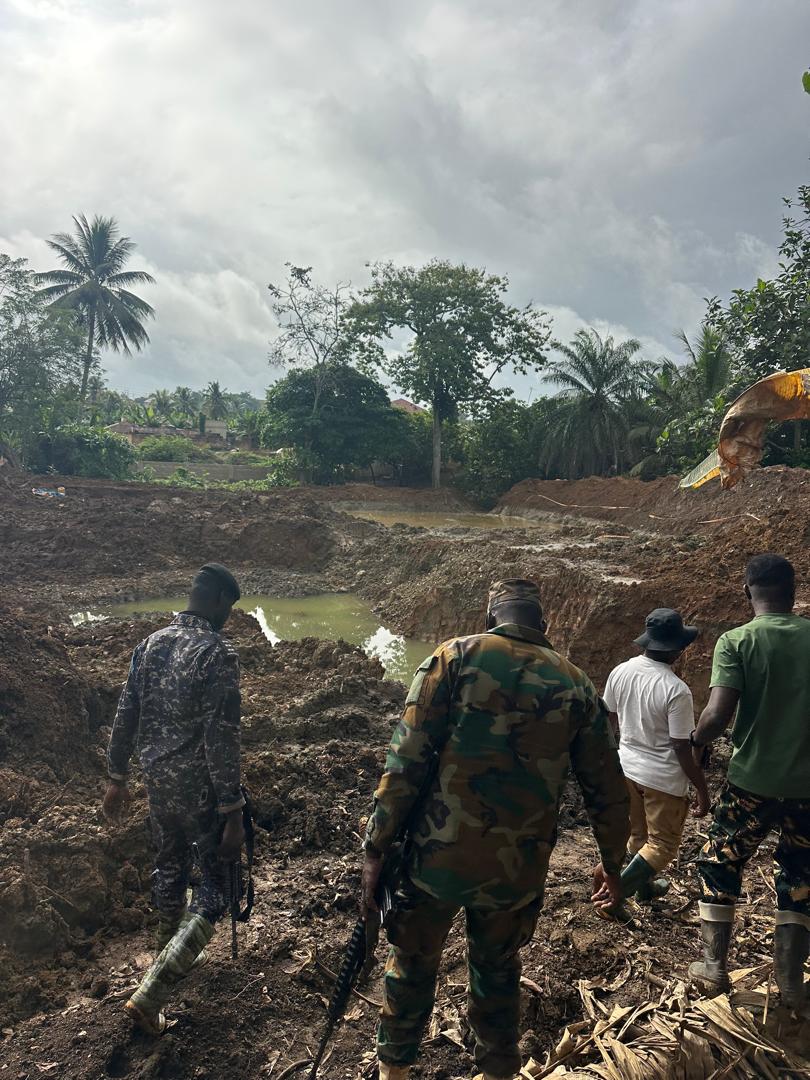
The NAIMOS team visited the affected site on Friday, August 7, 2026, following concerns raised on social media about the scale of environmental damage allegedly caused by mining activities in the area. The visit provided an opportunity for the Secretariat to assess conditions on the ground and establish the extent of the intervention already undertaken by local authorities.
During the inspection, officials examined the affected land and assessed the environmental consequences of the mining activity. Particular attention was given to the condition of the degraded area and the measures required to prevent further deterioration while ensuring that restoration efforts are properly implemented.
The NAIMOS delegation subsequently engaged traditional leaders and the Municipal Chief Executive (MCE), seeking information about the circumstances surrounding the mining activity, the parties involved and steps taken by the local administration to address the situation.
The engagement established that the individual believed to be responsible for the mining activity, whose name has been withheld, together with the landowners, had been arrested on August 5 and taken to the Kibi Regional Police Headquarters. They were subsequently granted bail on August 6, 2026, pending further proceedings.
The case has since moved beyond enforcement to the question of environmental accountability. The Municipal Assembly has initiated measures to address the damage, including requiring the miner to undertake reclamation of the degraded land under supervision.
“The real test of enforcement begins after the machines leave: damaged land must be restored.”
The reclamation requirement places environmental restoration at the centre of the response. Rather than allowing degraded land to remain abandoned after mining activity has ceased, the affected area is expected to undergo rehabilitation aimed at returning it to an acceptable condition.
NAIMOS welcomed the steps taken by the Assembly but stressed the importance of ensuring that reclamation is properly executed and continuously monitored. Effective supervision will be necessary to ensure that restoration commitments translate into tangible improvements on the ground rather than becoming another unresolved environmental obligation.
The Apedwa case illustrates the increasingly complex nature of Ghana’s response to illegal mining. Enforcement remains necessary to deter unlawful activities, but the consequences of mining can persist long after operations have stopped, leaving damaged land and disrupted ecosystems requiring significant rehabilitation.
“Stopping illegal mining is only half the battle; restoring what has already been damaged is the other half.”
The involvement of traditional authorities and the Municipal Assembly also underscores the importance of local institutions in Ghana’s anti illegal mining campaign. National enforcement agencies can intervene, but sustained environmental protection requires local authorities and communities to remain engaged long after an operation has ended.
For traditional leaders and local government authorities, the challenge is equally significant. Land governance, community livelihoods and environmental protection often intersect at the local level, making collaboration essential to preventing mining activities from returning once enforcement attention shifts elsewhere.
NAIMOS has reiterated that individuals involved in illegal mining must be held accountable for violations of the law and for the environmental consequences associated with their activities. That approach reflects a broader shift towards treating environmental restoration as an integral component of enforcement rather than an optional afterthought.
“Accountability must extend from the violation itself to the environmental cost left behind.”
The Secretariat says it will continue working with Metropolitan, Municipal and District Assemblies, traditional authorities, security agencies and other relevant institutions to combat illegal mining and promote the reclamation of degraded land. Such cooperation will be essential if isolated enforcement interventions are to produce lasting environmental results.
The Apedwa visit ultimately sends a broader message about Ghana’s fight against illegal mining: clearing a site is not enough. The land must be reclaimed, restoration must be monitored and local institutions must remain vigilant to prevent renewed degradation. As the authorities continue their work at Apedwa, the site has become a test of whether enforcement can be translated into genuine environmental recovery and stronger community protection.