

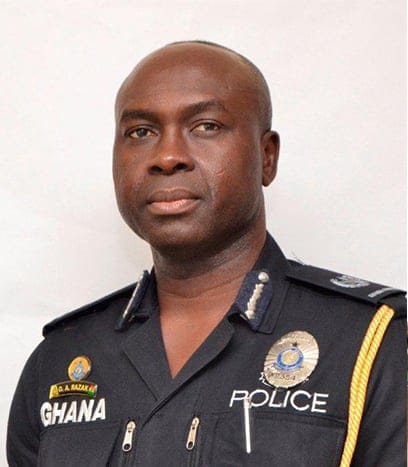
Story By: Felix Ernest Odamtten / Muhammed Faisal Mustapha
Ghana’s fight against political vigilantism is entering a more complex phase, with the National Security Coordinator, Osman Abdul-Razak, warning that the apparent disappearance of notorious vigilante groups from the streets should not be mistaken for the disappearance of the threat itself.
COP Abdul-Razak said political vigilantism was increasingly adapting to changing security and political environments, moving away from its traditional, highly visible form into networks that are more discreet, sophisticated and difficult to detect.
He identified social media platforms, encrypted communication channels, private security arrangements and informal networks as emerging avenues through which individuals and groups could organise, mobilise and potentially facilitate violence.
“Reduced visibility should not be mistaken for eradication,” the National Security Coordinator cautioned, delivering a stark message at a National Policy Dialogue on vigilantism and democratic security.
The dialogue, held at the Kofi Annan International Peacekeeping Training Centre (KAIPTC) in Accra, brought together senior government officials, security chiefs, political parties, traditional and religious leaders, Members of Parliament, representatives of the judiciary, diplomats, civil society organisations and the media.
The gathering was convened to assess the implementation and effectiveness of the Vigilantism and Related Offences Act, 2019 (Act 999), legislation introduced to confront political violence, intimidation and the activities of party affiliated vigilante groups.
COP Abdul-Razak acknowledged that Act 999 had produced an important shift in Ghana’s political landscape by substantially reducing the public visibility of organised political vigilante groups.
But he warned that the reduction in open displays of political muscle should not create a false sense of security, arguing that the phenomenon could simply be changing its appearance rather than disappearing altogether.
According to him, some groups were allegedly rebranding themselves as internal security teams, volunteer task forces or community security initiatives, while others had dissolved their formal structures and migrated into less visible networks.
The warning carries particular significance for Ghana’s democratic institutions, where political competition has historically generated concerns over the deployment of young people and informal groups to intimidate opponents, influence political processes or enforce partisan interests.
11. The National Security Coordinator further drew attention to the growing role of digital platforms, where political mobilisation can take place rapidly and with limited public visibility.
He said encrypted messaging applications and social media could provide channels for organising groups, disseminating inflammatory messages and coordinating activities outside conventional political structures.
The evolution of the threat, he suggested, requires Ghana’s security architecture to move beyond conventional monitoring and develop stronger intelligence led mechanisms capable of identifying emerging networks before they translate into physical violence.
Act 999, COP Abdul-Razak explained, was enacted to disband political party affiliated vigilante groups and criminalise acts or threats of violence and intimidation pursued in connection with political, land, mining or other interests.
Yet, despite the legislation, he acknowledged that prosecutions under the law had remained limited, while lengthy legal processes could undermine the deterrent value of the legislation.
The challenge, therefore, is no longer simply whether Ghana has legislation against vigilantism, but whether the law can be consistently, impartially and effectively enforced.
COP Abdul-Razak stressed that enforcement must be neutral, evidence based and insulated from political interference, warning that selective application of the law could weaken public confidence in the country’s democratic and security institutions.
He called for intelligence mapping and sustained stakeholder engagement to begin as early as 12 to 18 months before elections, allowing security institutions to identify potential flashpoints, emerging networks and risks before political tensions reach a critical stage.
As elections approach, he advocated intensified monitoring and preventive operations, coupled with stronger cooperation among the Ghana Police Service, Ghana Armed Forces, intelligence agencies, Ghana Immigration Service, Electoral Commission and other relevant institutions.
Such coordination, he said, would be essential to closing gaps that could otherwise be exploited by groups seeking to use violence or intimidation to influence political, economic or community interests.
The National Security Coordinator also issued a warning to private security companies and community based groups, stressing that they must not assume coercive powers that are legally reserved for the state.
His message extended beyond security institutions to Ghana’s political parties, which he urged to exercise restraint and responsibility in mobilising supporters, particularly young people who can easily become instruments of political confrontation.
He appealed to the youth to redirect their energy towards education, entrepreneurship, community development and nation building rather than becoming involved in political violence, intimidation or activities that could undermine the country’s democratic progress.
“Ghana has earned a respected place in the international community as a stable democracy. We must not trade this position for short term partisan advantage,” COP Abdul-Razak said, underscoring the wider national and international stakes involved in the fight against vigilantism.
His warning ultimately framed vigilantism as more than a political security problem: it is a threat to Ghana’s democratic credibility, social cohesion and development prospects. As the country seeks to consolidate its reputation as a peaceful democracy, the message from the National Security Coordinator is unequivocal the disappearance of vigilante groups from public view must never be confused with the disappearance of vigilantism itself.